
Every CBSE parent eventually asks the same question. Is online tuition actually as good as sending my child to a local tuition centre? This guide compares online tuition vs offline tuition on the factors that matter most. Cost, time, teacher access, personalisation and results tracking. By the end, you will know exactly where each model wins, and where it does not.
Key Takeaways
- Online tuition removes commute time entirely and gives students access to teachers beyond their own city or neighbourhood.
- Offline tuition centres offer familiar, in person structure, but often at fixed batch pace with less individual attention.
- Personalised online platforms like 90+ My Tuition App combine the best of both. Live teaching with chapter level focus.
The Real Question Parents Are Asking
Most parents do not actually want to choose between online and offline as a philosophy. They want their child’s marks to improve. That is the real question behind online tuition vs offline tuition. Which format gets a specific, struggling student to understand a specific, difficult chapter faster.
Offline tuition centres built trust over decades. Many parents attended one themselves. That familiarity is real, and it matters. But familiarity is not the same as effectiveness. A model can feel comfortable and still underperform for a student who needs a different pace.
This comparison does not claim one format is universally better. It breaks down where each model genuinely helps, and where it quietly falls short.
Both formats have existed side by side in India for years. What has changed recently is choice. A decade ago, most families only had local offline options nearby. Today, a strong online tuition app can reach a student anywhere with a stable internet connection, which is exactly why this comparison matters more now than it used to.
This guide focuses on CBSE families comparing options for Class 6 to 10, in line with CBSE curriculum guidelines. Younger and older students may weigh these factors slightly differently, but the core trade offs stay largely the same.
Cost Comparison: Online Tuition vs Offline Tuition Centres
What Offline Tuition Actually Costs
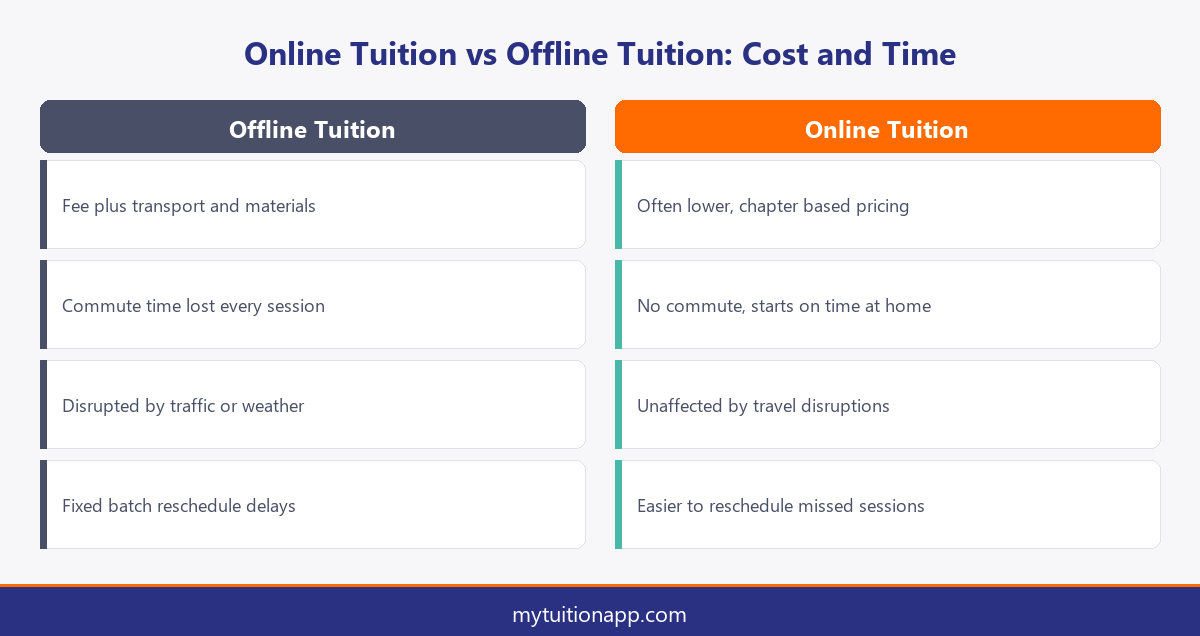
Offline tuition fees rarely stop at the monthly tuition fee. Parents also pay for transport, study material, and sometimes registration or seat booking charges. According to a 2025 national household survey, urban Indian households spend close to ten thousand rupees per student per year on coaching at the higher secondary level alone.
These figures often exclude petrol, auto fares or a parent’s time spent on daily pickup and drop. Add those in, and the real cost of offline tuition climbs further.
Offline centres also tend to charge per term or per year, not per chapter. If a student only needs help with two chapters in a subject, the family still pays for the full term. This is one of the least discussed costs of the offline model, and it adds up quickly across multiple subjects.
What Online Tuition Actually Costs
Online tuition removes transport costs entirely. Pricing also tends to be more transparent, especially on chapter based platforms. You can see our fees and formats checklist for a full breakdown of how different pricing models compare. Chapter based pricing, in particular, means you only pay for what your child actually needs.
This is not true of every online tuition app. Some still sell full subject bundles regardless of whether a student needs the whole syllabus retaught. Always confirm the exact pricing model before comparing cost across platforms.
There is also a smaller, easy to miss cost difference. Offline tuition often requires printed material, notebooks and sometimes lab access fees. Online tuition usually bundles digital material into the course itself, removing another small but recurring expense from a family’s monthly budget.
Add up fees, transport, materials and lost work hours for pickup and drop, and offline tuition often costs more than it first appears. Online tuition rarely carries these hidden extras, which is why comparing sticker price alone can be misleading.
Time, Travel and Flexibility
The Hidden Cost of Commute Time
A round trip to a tuition centre often takes thirty to sixty minutes, sometimes more in traffic heavy cities. For a student already juggling school, homework and multiple subjects, that lost time adds up fast across a full academic year.
Weather makes this worse. Heavy rain, flooding or extreme heat routinely disrupt attendance at physical tuition centres. A missed class due to travel disruption still needs to be caught up somehow, and that catch up rarely happens smoothly.
There is also an energy cost that is easy to overlook. A student who commutes after a full school day arrives tired before the lesson even begins. Tired students absorb less, no matter how good the teacher is.
Why Online Tuition Wins on Flexibility
Online tuition removes the commute entirely. A session starting at home starts on time, regardless of traffic or weather. This alone recovers hours of study time every week, time that can go toward practice, revision or simply rest.
Flexibility also extends to scheduling. Rescheduling a missed offline class often means waiting for the next batch slot. Many online platforms make this far easier, since sessions are not tied to a single physical room and a fixed group of students.
This flexibility matters even more during exam season. A student can fit an extra revision session into a free hour between school and homework. Arranging that with a physical tuition centre on short notice is rarely possible.
Teaching Quality and Access to Better Teachers
The Geographic Limit of Offline Tuition
A local tuition centre can only hire from the pool of teachers available in that specific city or neighbourhood. That pool may be excellent, or it may be limited, depending entirely on where a family happens to live.
A Wider Teacher Pool Online
Online tuition removes that geographic limit completely. A family in a smaller town can access the same teacher quality as a family in a major metro. This matters most for GCC based Indian families, who often have no local CBSE tuition centre option at all.
It is worth noting that teacher quality still varies between online platforms, just as it does offline. The format itself does not guarantee a good teacher. What it does guarantee is a wider pool to choose from, which improves your odds of finding a strong match for your child.
This wider pool also makes it easier to switch teachers if the first match is not working. Offline, switching often means changing centres entirely. Online, it can be as simple as requesting a different teacher for the next chapter, with far less disruption to the student’s routine.
A wider pool also means better subject specialists are easier to find. A rural offline centre may only have one Science teacher covering every class. A national online platform can offer a teacher who specialises specifically in Class 9 and 10 Science, which often shows in exam results.
Personalisation and Pace of Learning
Why Fixed Batches Hold Students Back
Most offline tuition centres run fixed batches. The syllabus moves forward on a schedule, whether or not every student has actually kept up. A student who misses one key concept often struggles silently through everything that follows, since the class cannot pause for one child.
Chapter Based Pacing With 90+ My Tuition App
This is exactly the gap the Personalised Chapter Model was built to close. Instead of a fixed batch, students work through individual chapters at their own pace, with a live teacher guiding each session. A student weak only in one topic focuses only on that topic, rather than sitting through material they already understand.
This kind of individual online tuition for CBSE students is hard to replicate offline at the same price. One to one offline coaching is usually the most expensive tuition format available.
There is a simple reason for this. A physical tutor working one to one can only teach one student per hour. A chapter based online platform can offer similar personal focus without that same scarcity, which is part of why it can stay more affordable.
Fixed batches also assume every student learns at roughly the same speed. In practice, this is rarely true, even among students in the same class. A chapter based model removes that assumption entirely, letting each student move at the pace their own understanding actually allows.
Doubt Clearing, Progress Tracking and Parent Visibility
Offline tuition centres rarely give parents a clear, ongoing view of progress beyond a report card or a teacher’s occasional comment. Parents often only learn about a gap after a poor exam result, when it is already late to fix easily.
Strong online tuition apps close this gap with visible progress reports and certifications after each chapter. Parents can see exactly which topics are done, which are still weak, and where to focus next, without waiting for the next parent teacher meeting.
Doubt clearing matters just as much. A live online teacher can answer a question the moment it comes up, the same as an offline teacher can. The real difference is not the format. It is whether the platform actually provides live access, rather than recorded video alone.
Some students also find it easier to ask a question online than in a crowded offline classroom. There is less fear of being judged by classmates. For a shy or anxious learner, this small shift can meaningfully increase how often they actually ask for help instead of staying quietly confused.
Progress visibility also changes how parents can help. A parent who can see exactly which chapter is weak can ask more useful questions at home. Instead of a vague check in about homework, the conversation becomes specific and genuinely useful.
Safety, Comfort and Learning Environment
Online tuition happens at home, under a parent’s supervision, without travel risk. For many families, that alone is a meaningful advantage. Students also avoid the social pressure that sometimes comes with a crowded offline classroom, which can help quieter learners speak up more freely.
Offline tuition centres do offer something online cannot fully replace. In person peer interaction and a dedicated study environment away from home distractions. For some students, especially those who struggle to focus at home, this structure genuinely helps.
This is a fair point, and it should not be dismissed. A student who cannot focus at home may need a parent to actively manage distractions during online sessions. That is a real adjustment some families need to make, not a reason to avoid online tuition altogether.
A quiet, consistent study corner at home, even a simple desk away from the television, usually solves most of this. It is a small setup cost compared to years of daily commuting to an offline centre.
Comparison Table: Online Tuition vs Offline Tuition
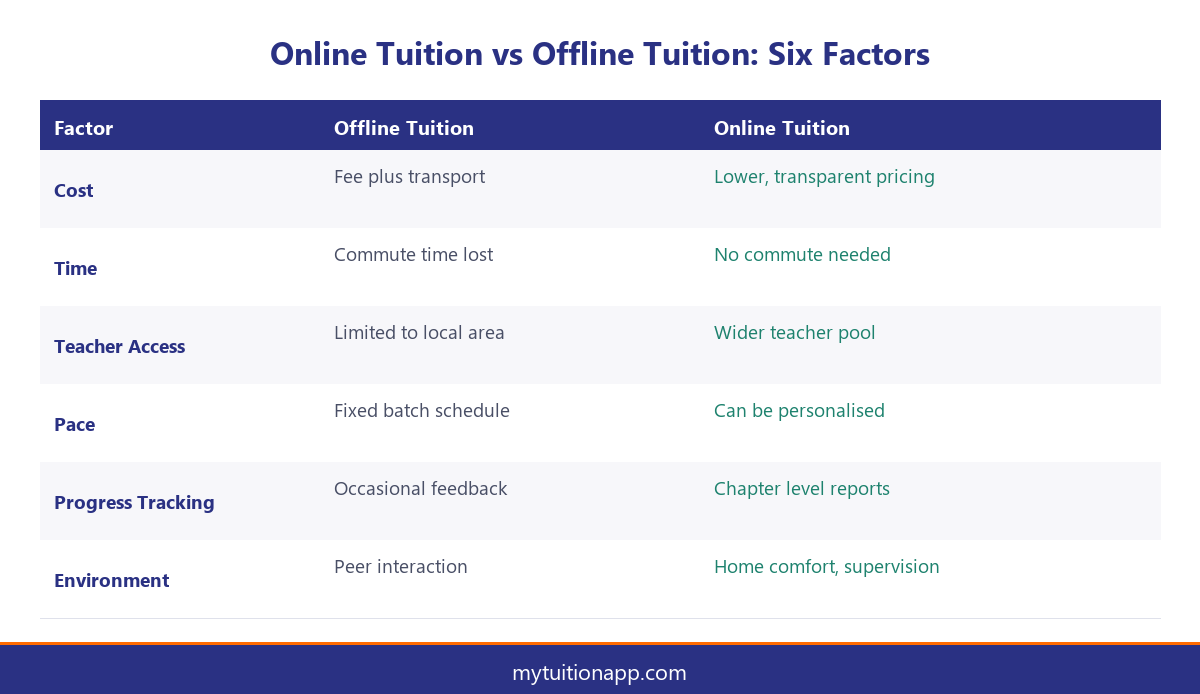
The table below summarises the trade offs across both formats. Use it as a quick reference, then weigh it against your own child’s specific needs.
Notice that online tuition wins clearly on cost, time and teacher access. Offline tuition holds its ground mainly on environment and peer interaction. For most CBSE families, the first three factors tend to matter more for actual exam results than the last one.
Personalisation and doubt clearing tend to decide the outcome most directly. A student who understands every chapter as it is taught rarely falls behind later. Cost and time savings matter, but they support that core outcome rather than replace it.
| Factor | Offline Tuition | Online Tuition |
|---|---|---|
| Cost | Tuition fee plus transport and materials | Often lower, especially chapter based pricing |
| Time | Commute time lost, weather disruptions | No commute, starts on time from home |
| Teacher Access | Limited to local city or neighbourhood | Wider pool, not limited by location |
| Pace | Fixed batch schedule for all students | Can be personalised, chapter by chapter |
| Progress Tracking | Report card, occasional teacher feedback | Ongoing reports, chapter level visibility |
| Environment | Dedicated space, peer interaction | Home comfort, parent supervision |
When Offline Tuition Still Makes Sense
Offline tuition still works well for students who thrive on in person structure and peer accountability. It also suits families who value a fixed, predictable schedule and a physical space clearly separate from home.
It can also suit families without reliable internet access, though this is becoming less common across most of urban and semi urban India each year. For these specific situations, a well run local tuition centre remains a genuinely reasonable choice.
Very young children, well below Class 6, may also benefit from the in person structure of a physical classroom before moving to independent online study. This comparison focuses specifically on Class 6 to 10, where most students can manage a personalised online format comfortably.
The honest answer is that neither format is automatically better for every student. What matters is whether the format actually addresses your child’s specific gaps. If you have not yet compared platforms directly, we compared the top 10 online tuition apps in India in a separate guide, which is worth reading alongside this one.
For families who want the structure of live teaching with the flexibility of online learning, a personalised platform is often the practical middle ground. It keeps the live, human element that makes offline tuition effective, while removing the commute and fixed batch pacing that often hold students back.
How 90+ My Tuition App Closes the Gap
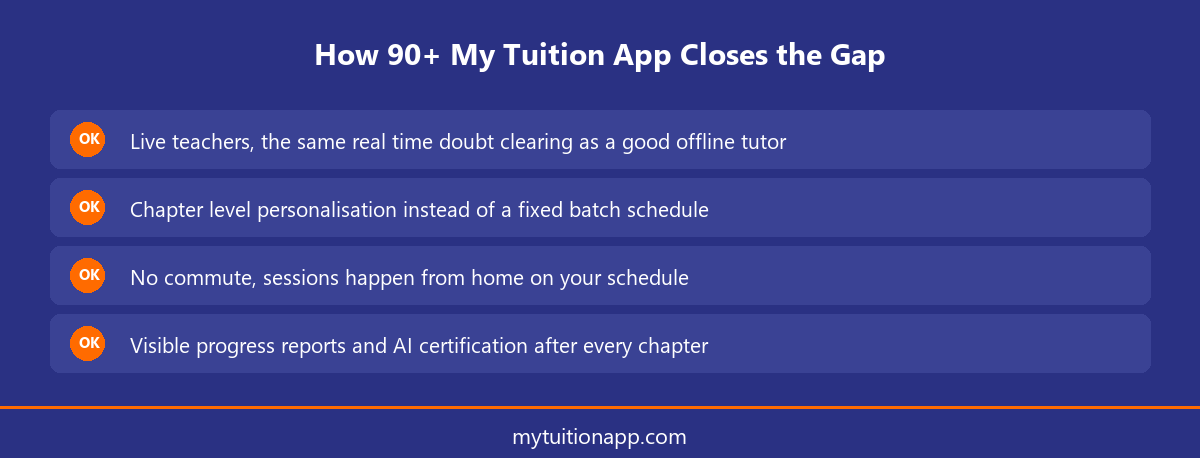
90+ My Tuition App was built specifically to combine what works about offline tuition with what works about online learning. Live teachers, real time doubt clearing and chapter level personalisation, without the commute, without the fixed batch schedule.
This matters most for the exact students this article started with. Those who are strong overall but stuck on a handful of chapters. A fixed offline batch cannot easily accommodate that. A large recorded video app cannot either. A live, chapter based online model can.
It is also worth comparing this approach against other apps directly, since not every online tuition app takes the same chapter first approach. Our ranking of other leading platforms shows how differently each one handles pacing and personalisation.
Students receive an AI certification as they complete each chapter, giving parents the kind of visible progress tracking that offline tuition centres rarely offer. You can review the full subjects covered on 90+ My Tuition App for Class 6 to 10, or start with starting online tuition in Class 6 if your child is new to online tuition.
As India’s online education sector continues to grow, more families are making this same comparison every year. The right choice comes down to matching format to need, not to habit alone.
Conclusion
Online tuition vs offline tuition is not really a contest between two philosophies. It is a question of fit. Offline tuition offers familiarity and in person structure. Online tuition offers flexibility, a wider teacher pool and, on platforms like 90+ My Tuition App, real personalisation.
If your child needs discipline and peer structure above all else, a good offline centre can still deliver that well. If your child needs pace, focus and someone who adapts to their specific gaps, a personalised online tuition app is very likely the stronger choice.
For most CBSE families in 2026, a personalised online tuition app delivers the live teaching quality of offline coaching without its biggest drawbacks. Curious what that looks like for your child? book a free demo class and compare it for yourself.
Frequently Asked Questions
Is online tuition better than offline tuition for CBSE students?
It depends on the student. Online tuition offers flexibility and wider teacher access, while offline tuition offers in person structure. Personalised online platforms often combine both advantages.
Does online tuition really save money compared to offline tuition centres?
Often, yes. Online tuition removes transport costs and, on chapter based platforms, avoids paying for full subject bundles a student does not need.
Can online tuition provide the same doubt clearing as offline classes?
Yes, if the platform offers live teacher access rather than only recorded video. Real time doubt clearing works the same way online as it does offline.
Is offline tuition safer than online tuition for children?
Online tuition happens at home under parent supervision, avoiding travel risk. Offline tuition offers a dedicated space and peer interaction that some students still value.
How does 90+ My Tuition App compare to a local tuition centre?
It offers live, chapter based teaching similar to a good local tutor, but with transparent pricing and progress tracking. See how online maths tuition changes across classes for a subject specific example.
Do online tuition apps cover the full CBSE syllabus like offline centres do?
Most established online tuition apps, including 90+ My Tuition App, cover the full CBSE syllabus for Class 6 to 10 across core subjects.
Why do some parents still prefer offline tuition centres?
Familiarity, in person structure and peer accountability. Many parents attended similar centres themselves and trust that experience for their own children, even when a different format might suit their child better.
Is online tuition suitable for a child who is weak in Maths?
Yes, especially with chapter based platforms. Read about moving from weak fundamentals to 90 percent in CBSE Maths for a real approach to closing gaps.
Can GCC based Indian families access good CBSE tuition online?
Yes. Online tuition removes geographic limits entirely, giving GCC based families access to CBSE qualified teachers that local offline options often cannot provide near their home.
What should parents compare before switching from offline to online tuition?
Compare cost, teacher access, personalisation and progress tracking. A free demo class is the fastest way to judge teaching quality directly before switching from an offline centre.