

Individual online tuition for CBSE students gets described in marketing copy so often that the phrase has started to lose meaning. It appears on nearly every tuition website, regardless of how classes are actually run behind the scenes. Many programmes labeled individual are still built around a fixed batch schedule with slightly smaller group sizes, not genuine one on one pacing. This guide looks at what individual tuition actually changes in practice. It compares individual tuition to batch tuition specifically, and shows where the difference matters most for a CBSE student.
Key Takeaways
- Individual is often used loosely to describe smaller batches, not genuine one on one, chapter based pacing.
- Batch tuition assumes every student needs the same amount of time on each chapter, which is rarely true in practice.
- Individual pacing changes doubt clearing speed, diagram review, and how specifically parents are updated on progress.
What Individual Actually Means Beyond a Marketing Word
Individual tuition should mean pacing genuinely follows one student, not that a batch has simply been made smaller than usual.
A batch of four or five students is sometimes marketed as individual or personalised attention. A smaller group does allow more teacher attention per student than a large classroom. But it still assumes every student in that smaller group needs roughly the same pacing through the syllabus. Genuine individual tuition works differently. A single student’s chapter progress, not a group’s average progress, determines how a session is paced. This is a meaningfully different structure, not simply a smaller version of the same batch model.
The distinction matters. Two students at very different points in understanding the same chapter still get treated identically in a small batch, just as they would in a large one. A genuinely individual model does not average across students at all. There is only one student’s pace to follow.
This confusion is not entirely the fault of tuition providers either. Individual has simply become a standard word in tuition marketing, similar to personalised or result oriented. It gets used broadly enough that it no longer reliably signals a specific teaching structure. The only way to know what a programme actually means by individual is to ask a direct question. How would a session change if two different students needed different amounts of time on the same chapter?
Batch Tuition vs Individual PCM Tuition
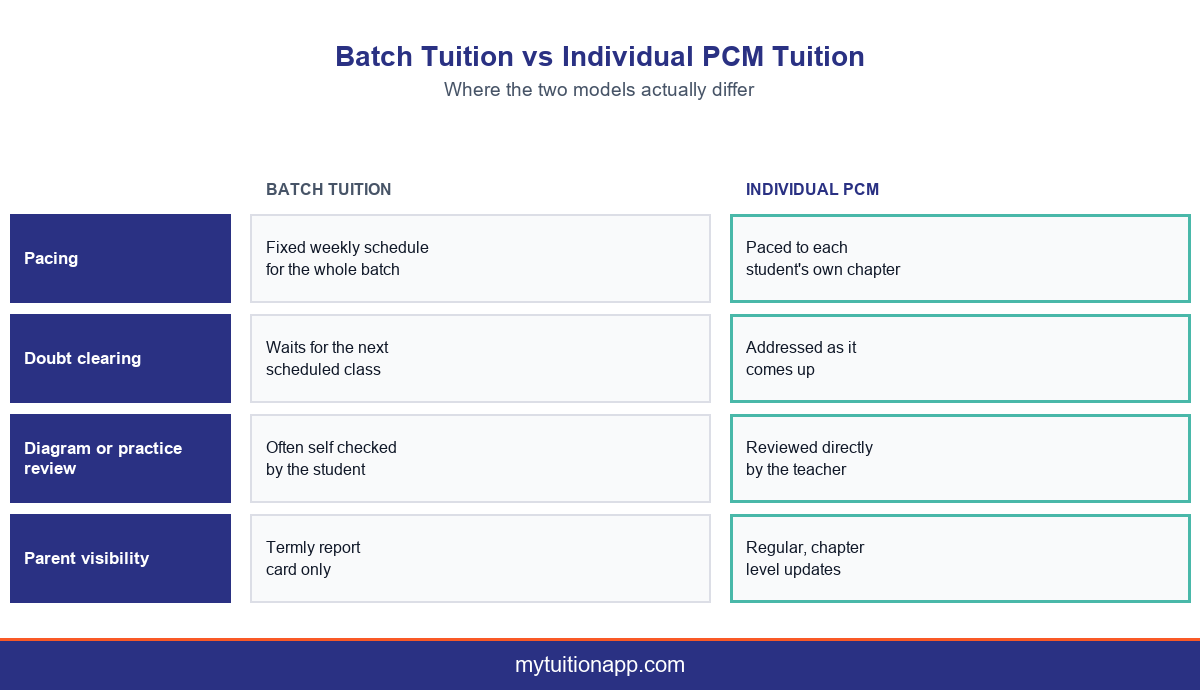
The two models differ most clearly in four areas. These are pacing, doubt clearing, diagram or practice review, and how parents are kept informed.
Batch tuition runs on a fixed weekly schedule set for the group as a whole. A student who needs extra time on a difficult chapter is still moved forward with everyone else. Doubts raised outside class typically wait for the next scheduled session, rather than being addressed as they come up. Diagram and written practice work is often left for the student to self check, since there is limited individual session time to review it directly. Parents, in turn, usually only see progress through a termly report card rather than regular, specific updates.
Individual PCM tuition changes each of these. Pacing follows the student’s own chapter progress. Doubts get addressed as they arise. Written and diagram work is reviewed directly by the teacher. Parents receive regular, chapter level updates, rather than waiting for a term report.
Where Batch Tuition Quietly Fails Students
The batch model works reasonably well for a student who happens to match the group’s average pace. It quietly fails students who do not.
A student slightly behind the group on a specific chapter, such as valency in Chemistry or algebraic identities in Maths, is typically carried forward regardless. A batch class cannot pause for one student without affecting everyone else. Over a full academic year, this compounds. A student with two or three unresolved gaps by the time Class 10 board preparation begins faces a harder task. They are now trying to close old gaps and learn new content simultaneously, a considerably harder position than closing each gap as it first appeared.
The reverse problem happens too. A student who grasps a chapter faster than the group average sits through repeat explanation and practice they no longer need. This happens simply because the batch schedule has not moved on yet. Neither situation is a flaw in the teacher’s ability. It is a structural limit of pacing a group of students as if they were one.
This is also why a batch student’s report card can look reasonably steady right up until Class 10. It can then drop noticeably once board level questions start expecting deeper application. Earlier, less demanding term exams often reward surface recall instead.
How Individual Pacing Changes a Typical Week
Under the Personalised Chapter Model, a week’s session plan is built around where a specific student actually is in the syllabus. It does not follow a shared class calendar.
A student who needs a third pass at a difficult Physics numerical gets it in the same week. There is no need to wait for a scheduled revision slot that may be weeks away. A student moving quickly through a chapter advances to the next one, without sitting through content they have already mastered. This is the same reasoning behind why chapter wise learning beats last minute exam prep. It applies here specifically to how individual pacing avoids the gap accumulation that batch tuition structurally allows.
This also changes what a parent actually sees week to week. Instead of a general note that a batch covered a certain chapter, updates describe specifically what a student worked on. They show where the student needed extra time, and what is planned next. This gives a much clearer picture of real progress than a shared class schedule ever can.
Is Individual Tuition Worth It for Every Subject
Individual pacing matters most for subjects that build cumulatively, such as Maths and Science. An early gap in these subjects directly affects a student’s ability to follow later chapters.
Subjects like Social Science or English still benefit from individual attention, but they are somewhat less cumulative in structure. A gap in one chapter does not always block understanding of the next one, the way an unresolved Maths or Chemistry gap does. This does not make individual pacing unimportant for these subjects. It does mean the case for it is strongest, and most measurable, in Maths and Science specifically, where CBSE students in Class 6 through 10 most often fall behind.
A useful approach for many families is to prioritise individual pacing first for whichever subject is genuinely weakest. There is no need to apply it equally across every subject from day one. A student solid in English but struggling in Chemistry gets more practical benefit from individual pacing concentrated where the actual gap is. Spreading it thinly across subjects that do not need it as urgently helps less.
Individual Should Mean the Student Sets the Pace
Individual online tuition for CBSE students only delivers real value when pacing genuinely follows a single student’s chapter progress. It should not simply describe a smaller version of the same batch model. The difference shows up most clearly in doubt clearing speed, diagram and practice review, and how specifically parents are kept informed of progress. Book a free demo class to see what genuinely individual, chapter based pacing looks like for your child.
Frequently Asked Questions
What does individual online tuition actually mean?
It means session pacing follows one student’s actual chapter progress specifically, rather than a group average. This differs from simply reducing the size of a batch class.
Is a small batch of 4 or 5 students the same as individual tuition?
Not quite. A small batch still paces to a group average. Genuine individual tuition paces to a single student, with no averaging across other students at all.
Why does batch tuition sometimes fail students who are not behind?
A student who grasps a chapter faster than the group average still has to wait for the batch schedule to move on. They end up sitting through content they no longer need to review.
Which subjects benefit most from individual pacing?
Maths and Science benefit most, since both build cumulatively. An early unresolved gap directly affects a student’s ability to follow later chapters.
How does individual tuition handle doubts raised outside class?
Doubts are addressed as they come up, rather than waiting for the next scheduled session. This is a key practical difference from a fixed weekly batch model.
Does individual tuition mean more parent visibility into progress?
Yes. Individual pacing typically comes with regular, chapter level updates. Batch tuition, by comparison, often leaves parents with only a termly report card.
Is individual tuition more expensive than batch tuition?
Our fees and formats checklist compares pricing and format across batch sizes. It is worth reviewing alongside this comparison of teaching approach.
Can a student switch from batch to individual tuition mid year?
Generally yes, though it depends on the specific programme. The structural benefit of individual pacing applies regardless of when a student starts. Earlier is easier though, for closing existing gaps.
Why do students lose interest in batch style tuition over time?
Our guide on why CBSE students lose interest in traditional coaching covers this same idea. A one size pace, whether online or offline, tends to disengage students on either end of the group’s average.
How can a parent tell if a programme is genuinely individual rather than just a small batch?
Ask directly how pacing is decided for one student specifically. Would two students at different points in the same chapter be taught differently, or identically?