Personalized Chapter Model tuition is changing how CBSE students in Grades 6 to 10 close learning gaps. Instead of committing to an entire subject for months, families can book only the chapters a child is struggling with, then verify learning through daily assessments. This guide explains how 90+ My Tuition App built two connected systems, the Personalized Chapter Model and Double Power Tuition, around a simple idea: real learning should be provable, not assumed. You will find grade-specific applications, parent reporting details, and links to deeper guides on every part of the model.
Key Takeaways
- PCM lets students book single weak chapters instead of enrolling in a full subject package, so support matches the actual gap identified in recent school tests.
- Double Power Tuition verifies learning with a daily short exam and a written assessment after every chapter, so progress is confirmed rather than assumed.
- The model adapts across Class 6 to Class 10 and supports CBSE families in India as well as NRI households across the UAE, Qatar, Saudi Arabia, Kuwait, Oman, and Bahrain.
What Is the Personalized Chapter Model?
Most tuition providers sell a subject. A student enrols in Class 9 Science for the full term, whether they are weak in one chapter or five. The personalized chapter model tuition approach at 90+ My Tuition App works differently. Parents and students choose the exact chapters that need support, whether that is Chemical Reactions in Chemistry or Linear Equations in Maths. A student can book two chapters in Physics this month and switch to three chapters in Social Science next month, without paying for content they already understand. This chapter-level structure suits CBSE learners because the syllabus itself is organised in chapters with clear learning outcomes.
Consider a Class 9 student who scores well in Biology but consistently loses marks in two Chemistry chapters, Atoms and Molecules and Structure of the Atom. Under a fixed-subject model, that student would still sit through every Chemistry chapter at the same pace as classmates, whether or not the content is new. Under PCM, the family books only those two chapters, works through them with a teacher who focuses specifically on that portion of the syllabus, and completes a Double Power verification exam once each chapter is done. If the verification exam shows the concept still needs work, the same chapter can be revisited before moving on, something a fixed monthly subject schedule rarely allows without falling behind on the rest of the syllabus.
90+ My Tuition App describes itself as the World’s First Personalized Chapter Model Tuition for CBSE, a claim tied directly to this chapter-level structure rather than a marketing label. The model was designed specifically around how the CBSE syllabus is already organised into discrete, testable chapters, so booking at that level is a natural fit rather than an artificial split. Families new to the model often start with a single chapter to see how the verification cycle works before committing to a longer-term plan across multiple subjects.
How Chapter Booking Works
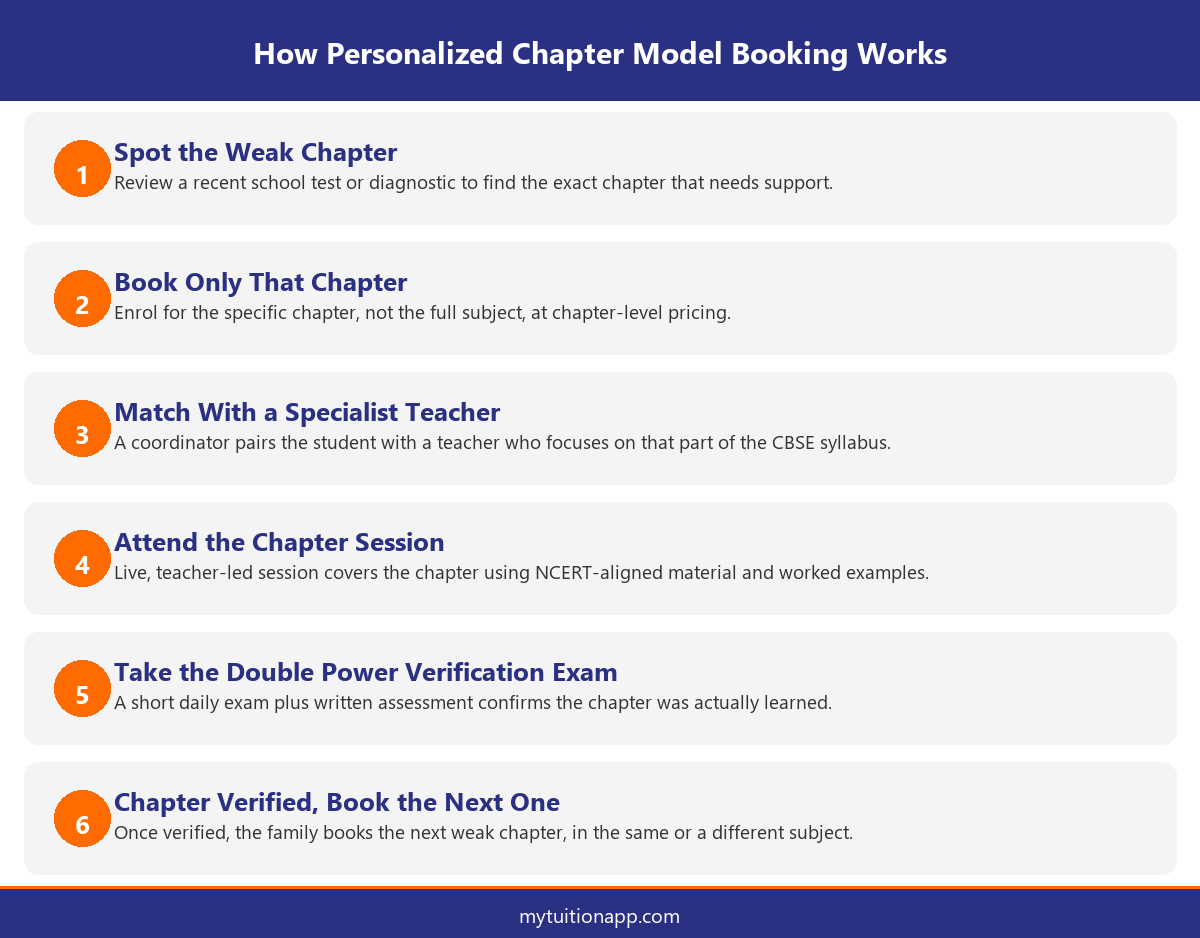
Booking starts with a quick diagnostic conversation or a review of recent school test papers. A learning coordinator identifies which chapters need attention, then matches the student with a subject teacher who specialises in that portion of the CBSE syllabus. Sessions are scheduled around the chapters booked, not a fixed subject calendar, so a family can start within days rather than waiting for a new term to begin. Once those chapters are complete and verified through Double Power assessments, the family can book the next set of weak chapters, whether in the same subject or a different one entirely. This keeps tuition spend tied to actual need rather than a flat monthly subject fee that covers content the student may not need.
How It Differs From Fixed Packages
Fixed-syllabus coaching charges for an entire subject regardless of what a student already knows. A child who is strong in Algebra but weak in Geometry still sits through both under a fixed package, paying the same fee either way. PCM removes that inefficiency by billing and scheduling at the chapter level, so families pay only for the specific chapters a student needs to revisit. This distinction becomes especially important during exam preparation, when time spent revisiting already-mastered chapters is time taken away from the two or three chapters that actually need repair before the next school test or board exam. Chapter-level billing also makes it easier for parents to track exactly where the tuition budget is going each month.
Double Power Tuition: India’s First Learning Verification Model
Booking the right chapter solves half the problem. The other half is confirming the chapter was actually learned. Double Power Tuition is positioned as India’s First Learning Verification Tuition Model, built around one simple rule: if it’s not verified, it’s not learned. After every chapter, students sit a short daily exam and complete a written assessment that mirrors CBSE exam patterns. Teachers do not move to the next chapter until the current one is verified, which prevents the common pattern where a student nods along in class, appears to understand, then struggles on the actual chapter test or board exam months later.
The name Double Power reflects the two layers involved: teaching power and verification power working together in every session. A typical chapter cycle runs through three stages. First, the teacher covers the chapter with worked examples drawn from NCERT-aligned material. Second, the student attempts a short daily exam focused only on that chapter’s core concepts. Third, the student completes a written assessment, generally one or two long-answer style questions, that the teacher grades personally rather than through automated scoring. Only after all three stages are complete does the chapter get marked verified in the student’s progress record. This structure exists specifically because CBSE board exams reward written accuracy and stepwise working, not just a correct final answer, so verification has to test the same skill the board exam will test.
This is the core philosophy behind the tagline used across every Double Power session: if it’s not verified, it’s not learned. It is a deliberately strict standard. A student who can solve a problem with the teacher watching but freezes during the independent written assessment has not yet demonstrated verified learning, and the chapter stays open until that gap closes.
What a Verification Exam Looks Like
A verification exam is short by design, usually 10 to 15 minutes, and focused only on the chapter just taught. Questions mix direct recall, applied problems, and one or two CBSE-style long-answer questions to check written expression, not just the final answer. Students in Class 10 preparing for board exams see verification exams that closely resemble the daily verification exams used across Maths and Science, so the format never feels unfamiliar on exam day. A teacher reviews the written assessment personally rather than relying on auto-graded multiple choice alone, and flags specific mistakes, such as a missing step in a Maths proof, rather than giving only a single overall score.
What Parents See in Reports
After each verification exam, parents receive a report showing the chapter covered, the score, common mistakes, and a plain-language note on whether the chapter is verified or needs revision. Reports are sent through the parent dashboard and, for many families, a WhatsApp summary as well, so there is no need to log in separately to stay updated. Class 9 parents managing combined Maths and Science tuition often want a walkthrough of how to read these reports chapter by chapter, since two subjects generate two parallel verification tracks. Our guide on reading your Class 9 Double Power progress report explains each column and what a low verification score actually means for the next session.
Grade-Specific Applications: PCM From Class 6 to Class 10
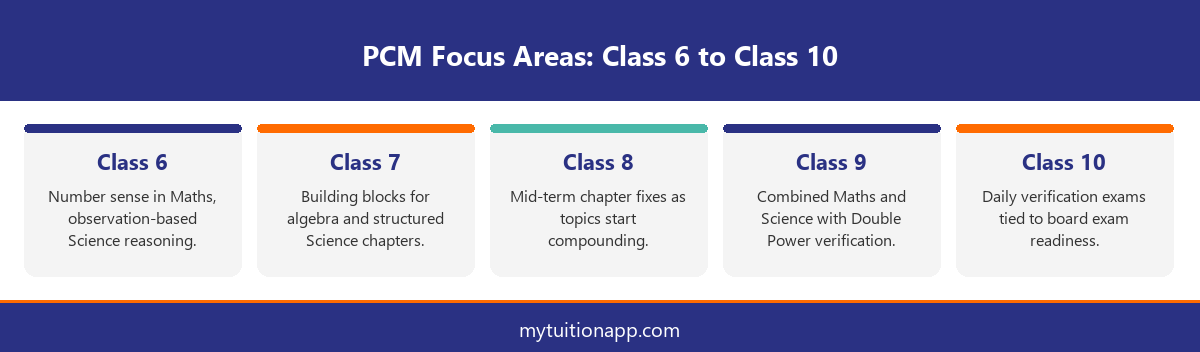
The Personalized Chapter Model looks different at each grade because CBSE demands change every year. In Class 6 and Class 7, chapters are typically booked to build number sense in Maths and observation-based reasoning in Science, since these years set the foundation for harder concepts that arrive from Class 8 onward. Class 8 marks a clear turning point. Topics like Rational Numbers, Linear Equations, and Force and Pressure start compounding, meaning a small gap in one chapter can affect performance in later chapters that build on it. Families frequently use PCM mid-term the moment a school unit test reveals a weak chapter, rather than waiting for the next term to start a new subject enrolment. Our detailed look at how PCM supports Class 8 Maths and Science mid-term shows exactly how that adjustment happens, including how quickly a new chapter booking can begin after a poor test result.
Class 9 introduces heavier Science content spread across Physics, Chemistry, and Biology alongside more abstract Maths topics like polynomials and coordinate geometry, so combined-subject support becomes common at this stage, paired with Double Power verification to catch gaps before Class 10 board pressure builds. Class 10 is where verification matters most, since every chapter feeds directly into board exam performance and there is little room left to revisit missed topics once board exams approach. Students at this stage often pair chapter bookings with a structured worksheet to track which topics are fully verified and which still need another pass. Our chapter-wise study plan worksheet for CBSE Class 10 gives parents a simple way to map booked chapters against the full syllabus and spot gaps before they become a problem in the exam hall.
Subjects Covered Under the Personalized Chapter Model
PCM is not limited to Maths and Science, even though those two subjects generate the most demand from CBSE families. 90+ My Tuition App applies the same chapter-level booking to Physics, Chemistry, Biology, Social Science, English, Arabic, Hindi, and French, covering the full spread of subjects a student needs across Grades 5 to 12. A student weak in one History chapter within Social Science can book just that chapter rather than committing to the entire subject for a term. Language subjects work the same way. A Class 7 student struggling with a specific grammar unit in Hindi or a comprehension chapter in English can book focused sessions instead of generic conversation practice that may not target the actual weak area. Chapter boundaries used for booking follow the structure set out in the official NCERT curriculum, so what a student studies in tuition matches what appears in the school textbook.
This subject breadth matters because CBSE weaknesses rarely sit inside a single subject. A student might be strong in Biology but weak in two Chemistry chapters and one Social Science unit in the same term, a pattern that is common heading into Class 9 and Class 10 when subject content becomes denser. PCM lets a family address all three gaps in parallel, each billed and scheduled at the chapter level, instead of juggling three separate full-subject enrolments with three different fee structures. For NRI students, the same subject list applies, with Arabic and French bookings often used to maintain fluency alongside core CBSE subjects, giving expat families a single tuition partner for both academic and language needs rather than separate providers for each.
PCM vs Fixed-Syllabus Coaching: Why Chapter-Level Wins
Fixed-syllabus coaching has one structural weakness: it prices and paces content by subject, not by what a specific student needs. A parent paying for a full Class 10 Maths package is effectively subsidising chapters their child has already mastered, while the actual weak chapters, often just two or three out of twelve or more, get the same generic pace as everything else. PCM inverts this by starting from the gap, not the subject. Enrolment, scheduling, and pricing follow the chapters actually booked, so a student weak in Trigonometry and Statistics gets concentrated attention on exactly those two topics instead of a diluted pass through the entire Maths syllabus.
The difference shows up most clearly at exam time. Fixed coaching often runs out of time to revisit early weak chapters because the calendar is built around finishing the syllabus once, in a fixed order, from start to finish. PCM allows a family to return to a previously booked chapter for a refresher session if a school test shows the concept slipped, without restarting an entire subject enrolment or paying for months of content already covered. For parents comparing both models before choosing a tuition partner, our side-by-side comparison of PCM against fixed-syllabus coaching breaks down cost per chapter, time commitment, and typical score improvement across CBSE Classes 6 through 10, using real chapter examples rather than general claims.
Parent-Facing Progress Reporting and the Double Power Report
Every verified chapter feeds into a running progress report that parents can check anytime through the dashboard. The report shows chapter-wise verification status, trend lines across recent weeks, and flags for any chapter that needed a repeat assessment before passing. This differs from a typical term-end report card. Instead of finding out at the end of the term that a subject needs work, parents see chapter-level signals within days of each session, while there is still time to book a focused follow-up before the gap widens further. Many parents describe this as the first time they have had visibility into their child’s understanding between school report cards, rather than only at the end of each term.
For Class 9 families managing combined Maths and Science tuition, the report becomes especially useful because it separates performance by subject and by chapter within each subject, rather than blending everything into one score. Reports are structured to mirror how continuous assessment is meant to work under the framework set out in official CBSE academic guidelines, so the categories parents see, conceptual understanding, applied problem-solving, and written accuracy, line up closely with what actually shows up on a CBSE answer sheet. Parents who want more detail on how to interpret each section, including what a partially-verified chapter score means for revision planning, can reach out to a learning coordinator directly through the enrolment process.
Who Benefits Most: CBSE Families in India and NRI Families Across the GCC
PCM and Double Power Tuition were built for two overlapping groups of families. The first is CBSE households across India where a student is generally doing fine overall but has specific weak chapters that keep costing marks, exactly the kind of narrow, persistent gap that fixed-subject coaching struggles to address efficiently. The second is NRI families in the UAE, Qatar, Saudi Arabia, Kuwait, Oman, and Bahrain, who need CBSE-aligned support delivered live across different time zones, often without a nearby coaching centre that teaches the Indian curriculum. Both groups share the same underlying need: a way to confirm that a specific chapter has actually been learned, not just covered.
For both groups, live scheduling matters more than convenience alone, since a verification exam only works if a teacher is present to assess the written response in real time. Families comparing live sessions against recorded video tuition often assume recorded content saves time, but it removes the verification step entirely, since there is no teacher available to grade a written response or flag a mistake in the moment. Our comparison of live classes against recorded tuition for CBSE students explains why the Double Power model depends on live, teacher-led sessions rather than passive video lessons, and what that trade-off means for a family juggling school timings across different countries and time zones.
What to Expect in Your First Month With PCM
Families new to the Personalized Chapter Model often want to know what the first few weeks actually look like before committing further. The process typically starts with a short call where a learning coordinator reviews the student’s most recent school test results or asks a parent to describe where marks are being lost. Based on that conversation, one or two starting chapters are recommended, usually the ones causing the most immediate concern, rather than an attempt to map the entire term upfront. A teacher is assigned within a day or two, and the first live session is scheduled around the family’s existing routine rather than a fixed institutional timetable. Most families see their first Double Power verification exam within the first week of sessions, which gives an early signal of how the model works before any longer-term commitment is made.
By the end of the first month, a typical family has usually completed two to four chapters, each with its own verification record, and has a clear sense of whether the pace and format suit their child. This is also when most parents start using the progress dashboard actively, checking scores after each session rather than waiting for a scheduled update. Because chapters are billed individually, there is no large upfront commitment required to test whether the model works for a specific student. Families who see strong verification results in the first month typically expand into additional chapters or subjects. Families who find a particular teacher or pace is not the right fit can adjust without losing the value of chapters already completed and verified, since the record travels with the student rather than resetting with a new enrolment cycle.
Conclusion
Personalized Chapter Model tuition works because it starts from where a student actually struggles, not from a fixed subject calendar. Paired with Double Power Tuition’s daily verification exams and written assessments, it gives CBSE families in India and across the GCC a way to confirm that a chapter is genuinely learned before moving on. Whether your child needs one weak chapter fixed in Class 8 or full board-exam readiness in Class 10, the model adapts to the actual gap. Book a free demo class to see how chapter-level booking and verified learning could work for your child.
Frequently Asked Questions
What is personalized chapter model tuition?
Personalized chapter model tuition lets CBSE students book individual weak chapters instead of enrolling in a full subject. Each chapter is taught and then verified through a short exam, so support matches the exact gap rather than an entire term-long subject package.
How is Double Power Tuition different from regular online tuition?
Double Power Tuition adds a daily short exam and written assessment after every chapter, verifying that learning actually happened. Regular online tuition usually moves through the syllabus without confirming a chapter is understood before starting the next one.
Can I book just one chapter instead of a full subject?
Yes. The Personalized Chapter Model is built around single-chapter booking. A family can enrol for one weak chapter in Maths or Science, complete verification, then decide whether to book another chapter in the same or a different subject.
Which grades and subjects does 90+ My Tuition App cover?
90+ My Tuition App covers CBSE and state board students from Grade 5 to 12, across Maths, Physics, Chemistry, Biology, Social Science, English, Arabic, Hindi, and French, each available through chapter-level PCM booking and verification.
How do NRI families in the GCC use this model?
Families in the UAE, Qatar, Saudi Arabia, Kuwait, Oman, and Bahrain use live, teacher-led sessions scheduled around local time zones. Our guide on CBSE tuition for Indian students across the GCC covers scheduling, verification, and subject options for expat households.
What does a Double Power verification exam actually test?
A verification exam checks recall, applied problem-solving, and written accuracy for the chapter just completed, mirroring CBSE exam patterns. Teachers personally review written responses, so students get feedback on how they would score on an actual answer sheet.
How often do parents receive progress reports?
Parents receive a report after every verification exam, not just at the end of the term. Each report shows the chapter covered, the score, common mistakes, and whether the chapter is fully verified or needs a revision session.
Is personalized chapter model tuition more expensive than a fixed subject package?
It is usually more cost-effective, since families pay for the specific chapters a student needs rather than an entire subject regardless of existing strength. Most families end up booking fewer total sessions once early weak chapters are verified and closed.
Can PCM help mid-term if my child suddenly falls behind?
Yes. Because chapters are booked individually, a family can add a weak chapter the moment a school test reveals a gap, without waiting for a new term or re-enrolling in a full subject package.
Does 90+ My Tuition App support NRI students on the CBSE curriculum?
Yes. Sessions follow the CBSE syllabus exactly, so NRI students transferring between India and the GCC stay aligned with their home curriculum. Our guide to online Maths and Science tuition for NRI students under the CBSE syllabus covers this in detail.