
Choosing between qualified CBSE online teachers and a local tutor shapes how well a child understands every chapter, not just how many hours get spent at a desk. A neighbourhood tutor can feel familiar and convenient, but subject depth and teaching consistency often vary widely from one household to the next. 90+ My Tuition App builds its classes around full-time Master Teachers who specialise by subject and grade, not generalists juggling five subjects at once. This article compares what qualified teachers offer against a typical part-time tutor, so parents can judge quality fairly before choosing where to invest a child’s study hours.
Key Takeaways
- 90+ Master Teachers are full-time, subject-specialist educators, not part-time generalists covering multiple grades.
- Every teacher is screened for subject depth, grade-level pedagogy, and communication skill before joining.
- Consistent teacher availability protects a student’s chapter-wise progress, unlike ad hoc tutor scheduling.
Who Really Teaches Your Child: Master Teacher vs Local Tutor
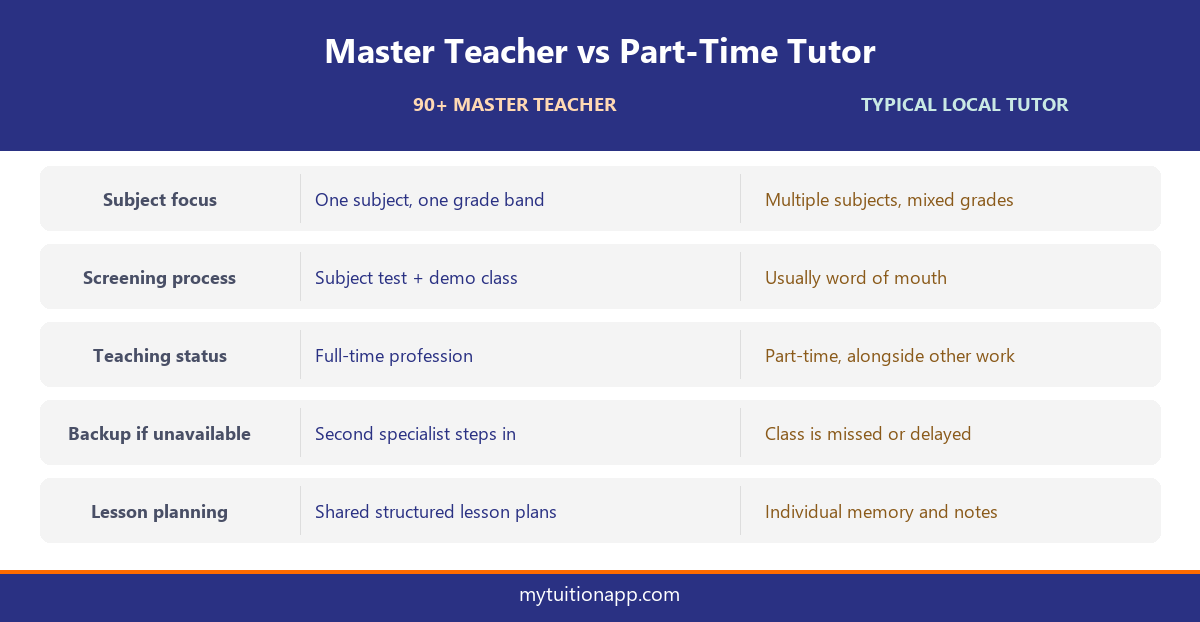
A typical local tutor is often a college student, a recent graduate, or someone tutoring part time between other commitments. That is not a flaw of character, but it does limit depth. Many capable local tutors are still building their own subject knowledge while teaching a child in grade 9 or 10, and they rarely have formal training in how to explain a concept three different ways until one finally lands. A Master Teacher on qualified CBSE online teachers vs local tutor platforms like 90+ teaches as a full-time profession, usually with several years of classroom or online experience in one subject and grade band. Parents rarely notice this difference until a chapter test reveals gaps in explanation rather than gaps in effort. Full-time teaching status changes how much preparation goes into every single class a student attends, from how examples are chosen to how a doubt gets anticipated before it is even asked. A parent evaluating any tuition option, online or local, should ask a simple question. Is this person teaching as their main profession, or fitting classes around something else? The answer usually predicts how consistent the coming year of chapters will feel for the student. It also affects how quickly a teacher notices a weak concept from an earlier grade that is quietly holding a student back in the current chapter, since spotting that pattern takes repeated exposure to how CBSE students typically struggle at each level.
Subject Specialisation: Why One Teacher Per Five Subjects Is a Problem
Many local tutors cover Maths, Science, and Social Science for the same student in one sitting, simply because that is what a small tuition setup can offer a family on a budget. Depth suffers when one person prepares five subjects across three grades every evening. A tutor teaching Chemistry to a class 10 student at 5pm and Class 7 English at 6pm cannot reasonably go as deep into either subject as someone who teaches only Chemistry, all day, to students at a similar level. 90+ assigns a separate specialist for each subject under its Personalised Chapter Model, so a student booking a weak chapter in Physics gets a Physics specialist, not a generalist reading ahead in the textbook the night before. This is one of the clearest markers of best CBSE teachers online: focused mastery of chapters mapped to the NCERT syllabus, rather than broad but shallow coverage across every subject a family happens to need. Subject specialisation also means a teacher has usually seen the same conceptual mistakes hundreds of times across different students, and knows exactly where a class 8 or class 9 learner tends to get stuck on a specific chapter. That pattern recognition is difficult to build when a tutor only meets a handful of students across scattered subjects each year, rather than teaching the same chapter to many different learners across a full academic session.
How 90+ Vets and Trains Its Master Teachers
Every Master Teacher joining 90+ goes through subject tests, a teaching demonstration, and a review of grade-level pedagogy before taking a single class. This is different from how many families find a local tutor, often through word of mouth with no structured screening at all. A neighbour’s recommendation says a lot about a tutor’s reliability and manner, but very little about whether that tutor can explain trigonometry identities or balance a chemical equation in a way a struggling class 9 student can actually follow. Professional online tuition teachers at 90+ also follow shared lesson planning across a structured learning ecosystem rather than teaching from memory alone, which keeps quality more consistent from one teacher to another. Parents can always ask what qualification and screening process stands behind any teacher, whether that teacher works online or in person nearby. A verifiable process is not a guarantee of perfection, but it is a meaningful safeguard that informal local arrangements rarely offer. It also gives parents something concrete to compare, rather than relying purely on a tutor’s confidence or a friend’s word. Screening at this level takes time and cost, which is part of why a single local tutor working alone finds it hard to match, however dedicated that individual tutor genuinely is to a student’s progress.
Availability, Continuity, and What Happens When a Tutor Leaves
A part-time tutor often has other commitments: college exams, a second job, or a family event, and lessons get rescheduled or cancelled without much notice. When a local tutor moves cities or simply stops tutoring, families must restart the search from scratch, and the new tutor rarely reviews exactly what was already covered before jumping into fresh chapters. That gap is where many CBSE students quietly lose months of preparation without parents fully realising it until a report card arrives. 90+ backs every subject with more than one specialist teacher, an approach that comes from operating at a scale a single local tutor cannot match. If a teacher is unavailable for one class, continuity does not depend on one person’s memory or on informal notes a tutor may or may not have kept in a personal notebook. A substitute Master Teacher can step in and see exactly which chapters and worksheets the student has already completed, so the class continues rather than restarts. For a family relying on steady, predictable progress toward a board exam, this kind of continuity often matters as much as the quality of any single class. It removes a single point of failure from a child’s preparation, which is difficult for any one local tutor to promise no matter how committed that person is.
What Qualified Teaching Actually Looks Like in a Live Class
The difference between a qualified teacher and a well-meaning tutor often shows up in small moments. A qualified CBSE online teacher plans a class around a specific learning outcome for that chapter, checks understanding with quick questions through the lesson, and adjusts pace when a student looks confused. A part-time tutor, working without formal training, may simply read through the textbook alongside the student, which can look like teaching without delivering the same depth of understanding. Neither approach lacks good intentions. The structural difference is training, feedback, and accountability to a broader system. Best CBSE teachers online are usually observed, reviewed against student results, and coached to improve, much like professionals in any other field. That accountability loop rarely exists for an individual local tutor working alone, since there is no one reviewing the quality of a single lesson beyond the family’s own impression at the end of the month. Parents often only discover a gap in teaching quality once board exam results arrive, which is far later than most families would prefer to find out. Sitting in on a trial class, whether with a prospective local tutor or an online Master Teacher, remains one of the simplest ways to see this difference for yourself before committing a full term of fees.
Conclusion
The gap between qualified CBSE online teachers and a local tutor is rarely about effort. It is about training, specialisation, and what backs up a teacher when a class is missed or a chapter needs revisiting. A part-time tutor can be caring and available, but a Master Teacher brings subject depth, formal screening, and a system behind every lesson. For grades 6 to 10 CBSE students, that difference shows up in chapter tests and board exam readiness alike. Book a free demo class with 90+ and see how a qualified Master Teacher plans a chapter differently from a part-time tutor.
Frequently Asked Questions
What is the real difference between qualified CBSE online teachers vs a local tutor?
Qualified CBSE online teachers specialise by subject and grade, follow structured lesson plans, and are formally screened before teaching. A local tutor often teaches multiple subjects informally, without standardised training, which can limit depth in board exam preparation.
Are online CBSE teachers actually more qualified than neighbourhood tutors?
Most established online CBSE platforms screen teachers through subject tests and demonstration classes before hiring. Neighbourhood tutors are usually chosen through word of mouth, so families rarely see formal proof of subject depth or teaching training.
Can a part-time tutor teach CBSE Maths and Science equally well?
It is possible but uncommon. Covering multiple subjects across grades every evening limits preparation time per subject. Professional online tuition teachers usually specialise in one subject, allowing deeper chapter-level preparation than a generalist tutor can offer.
How does 90+ select its Master Teachers?
90+ Master Teachers pass subject tests, deliver a demonstration class, and are reviewed for grade-level pedagogy before joining. This screening process is more structured than how most families select a local part-time tutor.
Why do local tutors often teach several subjects at once?
Small coaching setups and individual tutors usually take on whatever subjects a family needs, since narrow specialisation is not always financially practical for one person. This can reduce the depth of subject knowledge available to the student.
What happens if my child’s regular teacher is unavailable one day?
On 90+, every subject has more than one specialist teacher, and capsule notes and chapter wise worksheets keep the student’s record intact. A local tutor’s absence often means a missed class with no structured backup.
Is 90+ different from other online CBSE tuition platforms?
Yes. 90+ compares differently from traditional CBSE tuition platforms through its Personalised Chapter Model and full-time Master Teacher structure, rather than fixed monthly packages taught by generalist teachers juggling several subjects at once.
How can parents verify a teacher’s qualifications before enrolling?
Ask about the screening process, subject specialisation, and years of grade-specific experience. Reputable online tuition teachers can share this openly, while informal local arrangements rarely have a documented or repeatable hiring process to reference.
Do Master Teachers follow the CBSE syllabus closely?
Yes. Master Teachers plan lessons around the current CBSE curriculum and NCERT textbooks for each grade, updating chapter coverage as the board revises its syllabus, which keeps classes aligned with what students are actually tested on.
Is a local tutor ever a better choice than an online teacher?
A local tutor can work well for very young children or families wanting only homework supervision. For CBSE grades 6 to 10 focused on board exam performance, subject-specialist qualified teachers generally provide deeper, more consistent preparation.