
Online maths tuition for a Class 6 student should look nothing like tuition for a Class 10 student. Yet many generic programmes teach both the same way. The CBSE Maths syllabus changes in difficulty, structure, and exam weightage. This happens as a student moves from Class 6 through Class 10. The right online maths coaching should change with it. This guide walks through what changes at each stage. Parents can then judge whether a class 10 maths tutor online, or any online maths tuition class, fits their child. Fit matters more than age.
Key Takeaways
- Maths tuition needs shift from foundational number sense in Class 6 to 8, to algebra and geometry depth in Class 9, to board exam pattern mastery in Class 10.
- A class 10 maths tutor online should structure sessions around chapter weightage in the CBSE board exam, not just general problem practice.
- Chapter based online maths coaching lets a student spend more time on weak areas at any class level without waiting for a fixed batch schedule.
Why Class Level Changes What Online Maths Tuition Should Include
The CBSE Maths syllabus is cumulative. What a student needs from online maths tuition changes every year. This applies not just to difficulty, but to exam format and structure too.
Every class in the CBSE Maths curriculum builds directly on the previous one. A student with gaps in Class 7 fractions and ratios will struggle with Class 8 algebra. The same gaps carry into Class 9, since those chapters assume the earlier concept is solid. This is why generic online maths tuition often fails to close gaps. Structured the same way regardless of class, it treats every student as needing identical practice. In reality, a Class 6 student usually needs more foundational number work. A Class 9 student needs structured problem solving across longer, multi step questions. A Class 10 student needs exam pattern familiarity above almost everything else. Reviews of an online maths tuition class rarely mention this distinction. Yet it is the single biggest factor in whether a programme actually helps a specific child.
Consider two students enrolled in the same generic online maths tuition batch, one in Class 7 and one in Class 10. Both follow an identical weekly structure of live lecture, practice sheet, and short quiz. The Class 7 student gets more repetition than needed on straightforward topics. The Class 10 student gets far less exam specific practice than needed before boards. Matching the format, not just the subject, to the class is what separates coaching that genuinely helps. Coaching that simply fills weekly hours does not.
Class 6 to 8: Building Number and Concept Foundations
These years focus on number systems, fractions, basic algebra, and geometry fundamentals that later chapters depend on directly.
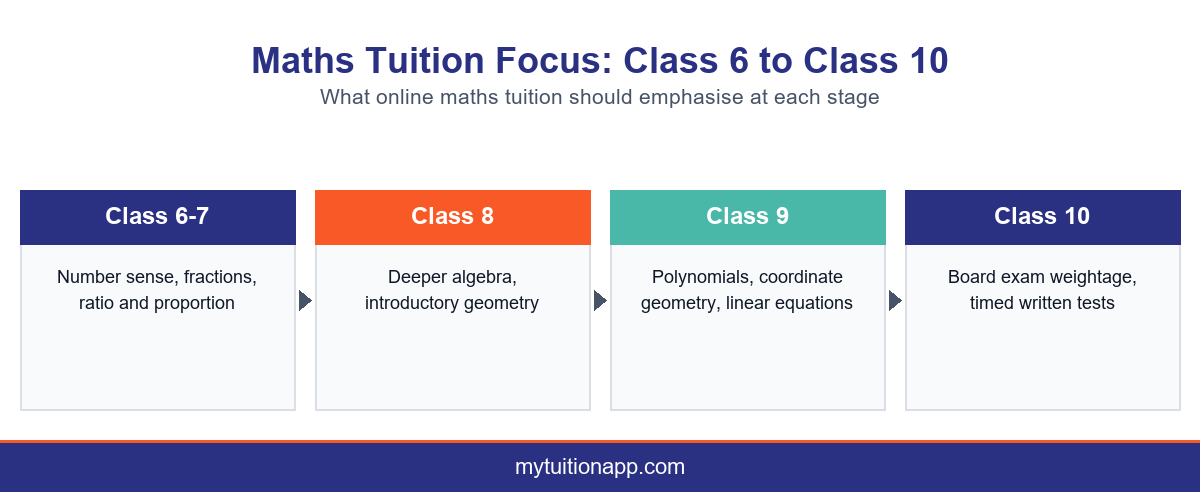
Online maths tuition for Class 6 to 8 should prioritise conceptual clarity over speed. Topics like fractions, decimals, ratio and proportion, basic algebra, and introductory geometry appear across all three classes in increasing depth. A student who memorises steps without understanding why they work tends to struggle. The moment a problem is phrased differently than the example, they get stuck. Good online maths coaching class 8 programmes spend extra time on word problems specifically. Translating a written scenario into the correct equation is the key skill here. More than any single topic, it determines performance in every class through Class 10. Chapter based formats work particularly well here. A student can spend an extra session on, say, ratio and proportion. This happens without slowing down a fixed batch schedule that has already moved to the next chapter.
Class 9: The Bridge Year Before Boards
Class 9 introduces harder algebra, coordinate geometry, and statistics. It carries no board exam, but weak Class 9 foundations directly undermine Class 10 performance.
Class 9 does not have a public board exam. Ironically, this makes it the year most likely to be under taught. Programmes that treat Class 9 as a low stakes year use less structured testing. This tends to send students into Class 10 with quiet gaps. Those gaps often sit in polynomials, linear equations in two variables, and coordinate geometry. These are exactly the chapters Class 10 depends on. A strong Class 9 online maths tuition programme uses the same rigour as Class 10, including regular written tests. It is the last full year available to fix gaps before board exam pressure begins. Parents evaluating a provider for Class 9 should ask directly whether the year is treated as preparation for Class 10. The alternative is a standalone year with lighter expectations. The answer reveals a lot about how seriously the programme takes long term outcomes.
Class 10: Board Exam Focused Maths Tuition
Class 10 online maths tuition needs a shift. Instead of general concept teaching alone, it should add chapter weightage awareness, exam pattern practice, and timed written tests.
A class 10 maths tutor online should be explicit about which chapters carry more marks in the CBSE board exam. Trigonometry, Quadratic Equations, and Statistics are common examples. Teaching time should follow that weightage, not be spread equally across every chapter. Programmes that skip this prioritisation often run out of time before board exams. They end up rushing through high weightage chapters at the end of the year. That is exactly when a student most needs steady, unhurried practice.
Alongside weightage awareness, look for regular written tests conducted under time limits, not just live teaching sessions. Producing a complete, correctly structured answer within a fixed time is a distinct skill. It differs from understanding a concept in a relaxed live class. Programmes that combine chapter based teaching with CBSE board exam pattern practice tend to produce steadier results. Programmes relying on live sessions alone rarely match that consistency. Students walk into the actual exam having already practised the exact format they will face.
It is also worth checking how a Class 10 programme handles two students at very different starting points. A rigid batch schedule forces both through the same revision calendar regardless of readiness. A chapter based structure works differently. One student can spend extra sessions reinforcing Quadratic Equations. The other moves ahead to Statistics. Neither student waits on the other.
Choosing the Right Online Maths Coaching for Your Child’s Class
The best online maths tuition provider changes its approach by class, not just its marketing. Ask class specific questions before enrolling.
When shortlisting a provider, ask class specific questions rather than general ones. For a Class 6 to 8 student, ask how word problems and foundational concept gaps are identified and addressed. For a Class 9 student, ask whether the year gets the same rigour as Class 10. Regular testing is one sign of this. For a Class 10 student, ask directly which chapters receive extra teaching time based on board exam weightage. Also ask whether written, timed tests are part of the regular schedule, not an occasional add on. A chapter based online maths tuition model, such as 90+ My Tuition App’s Personalised Chapter Model, is built to answer all three questions clearly. Chapter level pacing and reporting apply the same way at every class. Depth and focus adjust to what each specific class actually needs.
This matters even more for families with more than one child across different classes. Siblings often compare notes on a shared platform. If a Class 7 sibling and a Class 10 sibling are taught through the exact same weekly structure, one is likely being underserved. Ask a provider to explain, in concrete terms, how a Class 7 session differs from a Class 10 session on the same platform. This is a quick, practical way to confirm the fit before enrolling either child.
The Right Fit Changes by Class, Not Just by Provider
Online maths tuition is not one size fits all across Class 6 to 10. Many programmes market it that way anyway. Foundational number sense is the priority in Class 6. By Class 9, the priority shifts to rigorous preparation despite having no board exam. Class 10 students need chapter weightage awareness and timed written practice above all else. Ask any shortlisted provider how their online maths tuition class changes across these stages. Then use a free demo class to confirm the answer. It should match what actually happens in a live session, before you enrol for a full year.
Frequently Asked Questions
What is the best online maths tuition for CBSE Class 10 students?
The best programmes prioritise board exam chapter weightage, such as Trigonometry, Quadratic Equations, and Statistics. They combine live teaching with timed written tests, and report progress chapter by chapter rather than through generic assessments.
Does online maths tuition in Class 9 matter if there is no board exam?
Yes. Class 9 introduces polynomials, coordinate geometry, and linear equations that Class 10 depends on directly. Weak Class 9 foundations are the most common hidden cause of Class 10 struggles.
How is online maths tuition different for Class 6 compared to Class 8?
Class 6 focuses on number sense, fractions, and basic ratios. Class 8 builds on this with deeper algebra and introductory geometry, requiring more structured word problem practice than Class 6.
What should a class 10 maths tutor online focus on before board exams?
Chapter weightage, since some chapters carry disproportionately more marks. Programmes should also include regular timed written tests so students practise producing full answers under real exam conditions.
Can a chapter based online maths tuition model help a child who is behind?
Yes. Instead of following a fixed batch schedule, a student can spend extra sessions on specific weak chapters. There is no need to wait for the class to move on. This closes gaps faster than a rigid weekly timetable.
How many hours per week of online maths coaching does a CBSE student need?
This varies by class and current level, but 2 to 4 hours weekly is typical. Class 10 students often need more structured, exam focused hours closer to board exams.
Is online maths tuition available for NRI and GCC based CBSE students?
Yes. The CBSE Maths syllabus is identical regardless of location. GCC based students in the UAE, Qatar, Oman, Kuwait, Saudi Arabia, and Bahrain can use the same class specific programmes.
What topics carry the most weightage in the CBSE Class 10 Maths board exam?
Chapters such as Trigonometry, Quadratic Equations, Statistics, and Coordinate Geometry typically carry significant weightage. Exact marks distribution is published by CBSE each academic year.
How is a Personalised Chapter Model different from a normal maths batch?
Instead of a fixed weekly timetable, a student progresses chapter by chapter at their own pace. They move to the next chapter only after mastering the current one. This happens regardless of a normal maths batch‘s overall pace.
Why do students who cram before exams still underperform in Maths?
Cramming skips the steady, cumulative practice Maths requires. See our related article on why chapter wise online tuition beats last minute exam prep. It explains why spreading practice across the year works better.