
Choosing online tuition for a CBSE student in Class 6 to 10 means comparing more than just a price tag. Parents researching online tuition today face live classes, recorded lectures, batch programs, and one on one formats, each priced differently and structured differently. This guide breaks down how online tuition classes are actually priced, what formats exist, and what to check before you commit to online classes for students. By the end, you will have a practical 7 point checklist to evaluate any provider, including what a free demo class should reveal about fit for your child.
Key Takeaways
- Online tuition today spans four main formats: live, recorded, hybrid, and personalised chapter based learning, each with different pricing and outcomes.
- Fee structures vary by subject count, chapter access, and batch size, so comparing cost alone can be misleading.
- A structured 7 point checklist and a proper demo class are the two most reliable ways to judge fit before enrolling, especially ahead of the Class 10 board exam.
What Does Online Tuition Really Mean in 2026?
The term online tuition covers a wide range of services today, and that variety is exactly why comparison shopping confuses so many parents. At one end sit large recorded video libraries that a student watches on their own schedule. At the other end sit fully live, teacher led sessions where a student can ask questions in real time and get an answer before moving to the next problem.
In between are hybrid models: live sessions supported by recorded revision content, practice sheets, and periodic tests. Some providers organise online tuition classes around a fixed weekly timetable, similar to a school day. Others, including newer personalised chapter based models, let a student progress chapter by chapter at their own pace, only moving forward once a concept is genuinely understood.
For a CBSE parent, this matters because the CBSE syllabus for Class 6 to 10 is structured around chapters and units that build on each other, particularly in Maths and Science. A format that lets a student revisit a specific chapter, such as quadratic equations or chemical reactions, without waiting for a fixed weekly slot tends to close gaps faster than a rigid batch schedule.
It also matters because online tuition is not one product with one price. A parent asking whether online tuition is worth it is really asking several separate questions: is live teaching worth the additional cost over recorded content, is a smaller batch worth more than a larger one, and does my child need chapter level flexibility or a fixed structure to stay disciplined.
The next sections take each of these questions in turn, starting with format, since format is what determines almost everything else, including price. Providers with strong methodologies, such as 90+ My Tuition App’s Personalised Chapter Model, make both visible in a single free demo class, so a parent does not need to guess.
Cost comparisons become clearer once you standardise what you are actually comparing. Rather than asking what the monthly fee is, ask what the cost per live teaching hour, per subject, is for your child’s exact class. A provider quoting a lower headline fee for a 40 student batch may cost more per hour of real teacher attention than a provider quoting a higher fee for a 10 student batch or a chapter based model. Request this breakdown directly, since most providers do not volunteer it in their marketing materials, and use it as the baseline figure when comparing three or four shortlisted options side by side, rather than comparing sticker prices alone.
Live Classes, Recorded Lectures, or Hybrid: Which Format Fits Your Child?
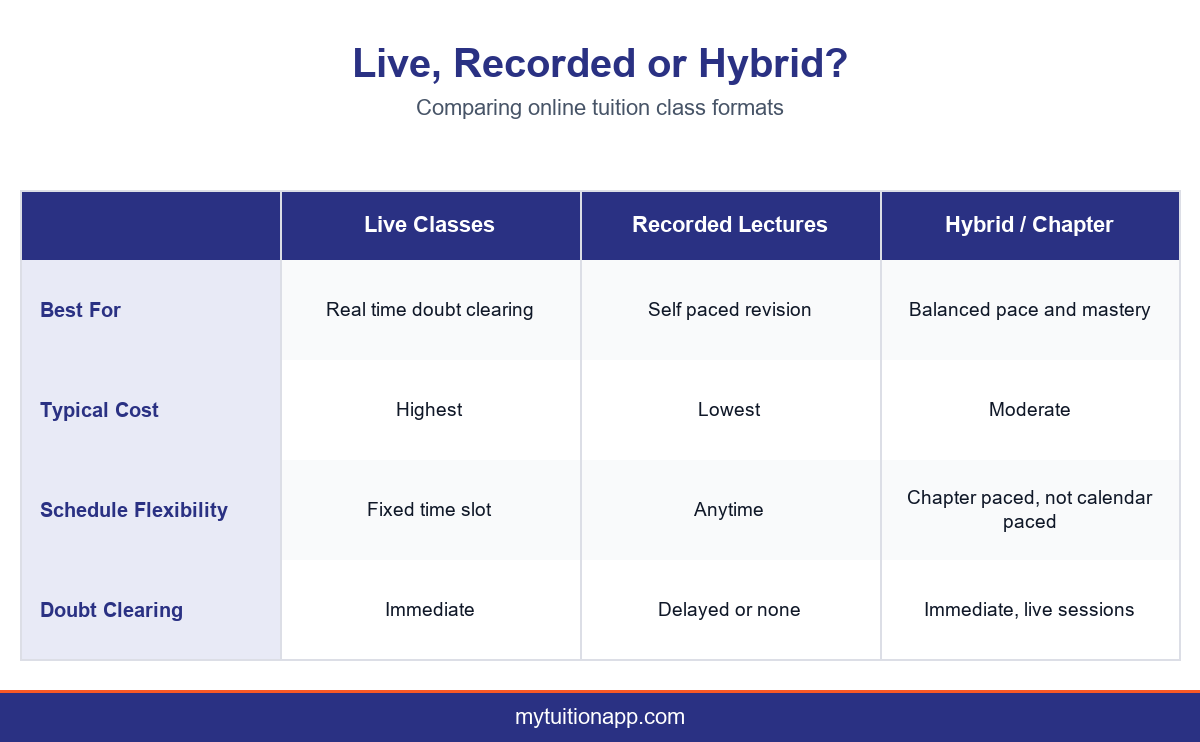
Every online tuition classes provider sits somewhere on a spectrum between fully live and fully recorded. Understanding where a provider sits, and where your child performs best, is the single most useful filter when comparing options for online classes for students.
Live Classes
Live classes replicate a classroom experience over video. A teacher explains a concept, takes questions, and can adjust pace based on how the class responds. For students who ask a lot of questions or need real time correction, especially in Maths problem solving, live sessions tend to produce faster improvement. The tradeoff is cost and scheduling: live teacher time is the most expensive resource in any tuition model, and live classes require the student to be available at a fixed time, which can be difficult for GCC based families managing different time zones and school schedules.
Recorded Lectures
Recorded lectures let a student watch at any time, pause, rewind, and repeat a difficult section as often as needed. They are usually the cheapest format and work well for confident, self motivated students revising a chapter before a test. The main limitation is the lack of real time doubt clearing. A student stuck on a specific step in a Science numerical has no one to ask immediately, and confusion can compound if it is not addressed quickly.
Hybrid and Chapter Based Models
Hybrid formats combine live teaching for new concepts with recorded content for revision, plus structured practice between sessions. Chapter based models go a step further by organising the entire course around individual chapters rather than a fixed weekly calendar, so a student who needs an extra week on Trigonometry is not forced to move on before they are ready. This is closer to how 90+ My Tuition App structures its Personalised Chapter Model, pairing live teaching with chapter level pacing so progress is measured by mastery, not by the calendar.
How Online Tuition Classes Are Priced: Fee Structures Explained
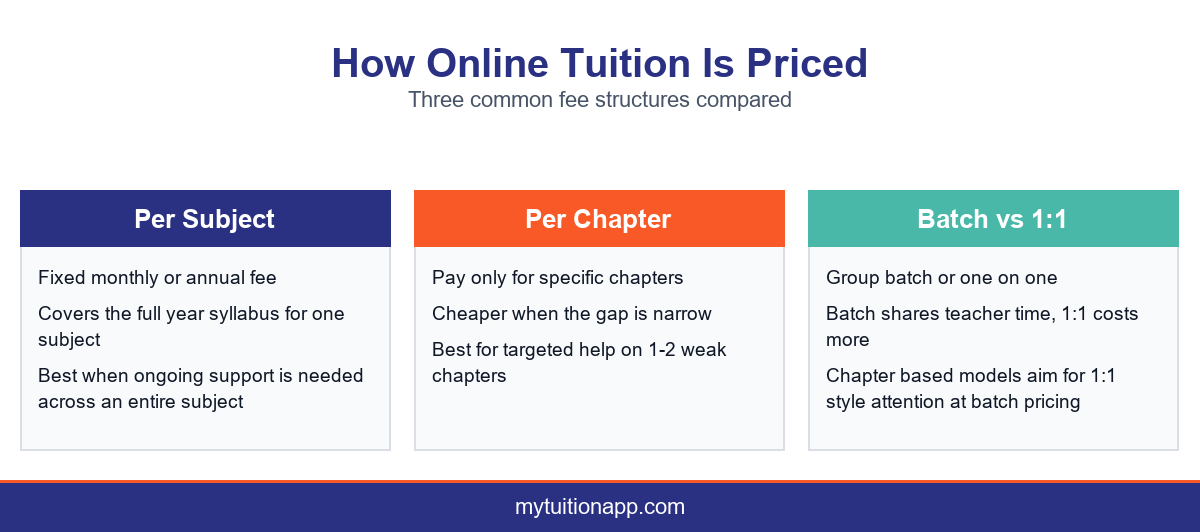
Once format is clear, fee structure is the next major variable. Most online tuition classes are priced using one, or a combination, of three models: per subject, per chapter, and per batch size. None of these is inherently better, but each suits a different need, and mixing them up is the most common reason parents feel they overpaid.
Per Subject Plans
This is the most familiar model: a parent pays a fixed monthly or annual fee per subject, such as Maths tuition or Science tuition, covering the full year’s syllabus. It is easy to budget for and works well when a child needs consistent, ongoing support across an entire subject rather than help with a handful of weak chapters.
Per Chapter Plans
Some providers, including chapter based models, allow a parent to pay only for specific chapters a student is struggling with, rather than a full subject. This can be significantly cheaper when the gap is narrow, for example a Class 10 student who is confident in most of Science but weak specifically in Chemical Reactions and Equations or Electricity.
Batch vs One on One Pricing
Group batches, typically 10 to 30 students, cost less per student because the teacher’s time is shared. One on one tuition costs more but gives full attention and lets the pace match one child exactly. A well run chapter based model tries to capture the benefit of one on one attention, live doubt clearing and pacing suited to the individual, at a batch level price point, which is why it is worth asking any provider directly how they resource live sessions before comparing headline fees.
Batch Size Matters: Group Batches vs a Personalised Chapter Model
Batch size is often overlooked, but it directly affects how much individual attention a student gets inside a live class, regardless of what the marketing materials promise. A class of 30 students, even with a live, qualified teacher, leaves very little time for one student’s specific doubt in a 45 to 60 minute session.
Smaller batches, around 5 to 10 students, allow more back and forth, but still divide teacher attention across every student present that day. This is the core limitation that personalised chapter based models are designed to solve: instead of organising the classroom around a batch, the curriculum is organised around each student’s chapter progress, so two students in the same subject can be at different chapters simultaneously and still each get a genuinely personalised session. This approach reflects a broader shift toward personalised learning in education systems worldwide, where pacing follows the learner rather than the calendar.
For a CBSE Class 10 student under exam pressure, this difference compounds quickly. A student who is behind by two chapters in a fixed batch schedule either falls further behind waiting for the batch to reach revision, or has to arrange separate catch up sessions at extra cost. A chapter based structure removes this problem by design, since there is no batch to fall behind.
When comparing options, ask directly what the maximum class size for a live session is, and whether the student moves at the batch’s pace or their own. The answer tells you more about expected outcomes than the price alone.
It is also worth asking how a provider handles a student who finishes a chapter faster than peers in the same subject. In a rigid batch, a fast student is often asked to wait for the group, which can slow momentum and reduce engagement over a full year. In a genuine chapter based model, that student simply advances to the next chapter, which matters just as much for a strong student aiming to get ahead as it does for one who is behind, since both scenarios are common within the same classroom in any given month.
A 7 Point Checklist Before You Enroll in Online Classes for Students
With format, pricing, and batch size covered, the last step is a structured way to compare providers side by side rather than relying on a sales call alone. The following 7 point checklist is designed specifically for CBSE parents evaluating online classes for students in Class 6 to 10, including families based in India and across the GCC.
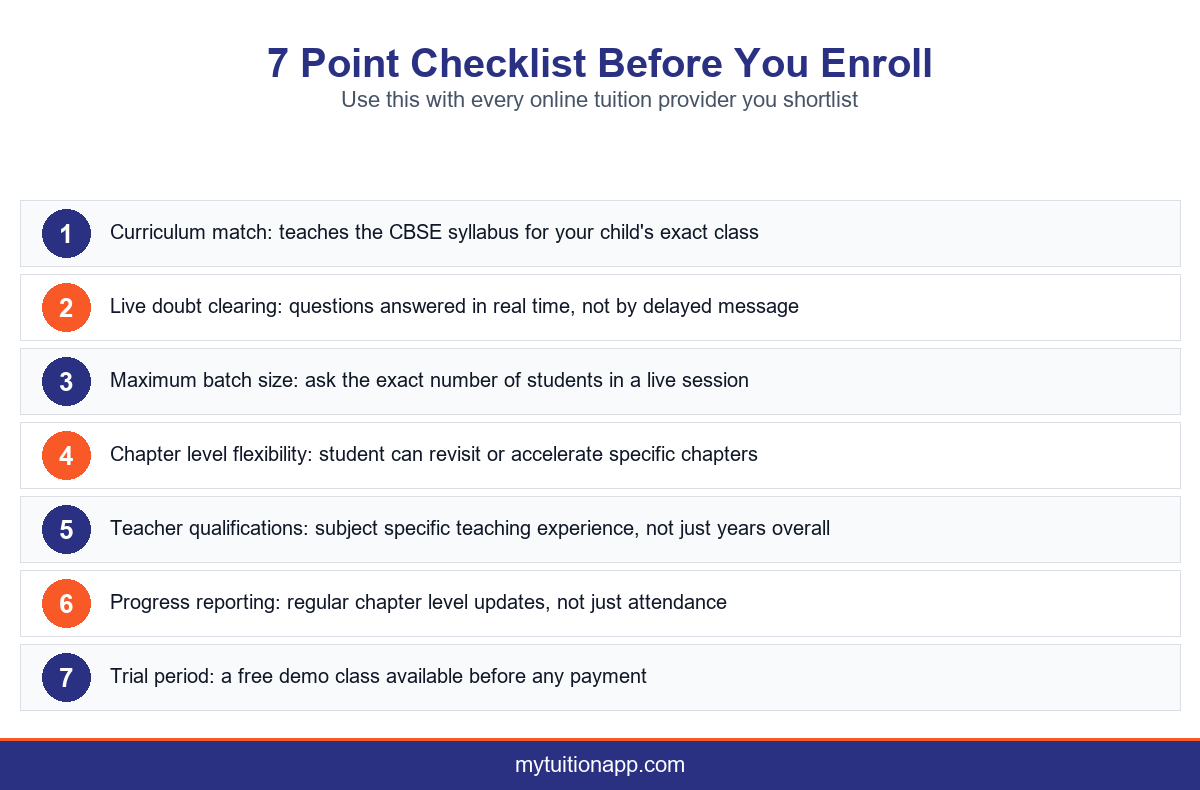
Running through all 7 points with two or three shortlisted providers, in the same call or comparison sheet, usually takes under 30 minutes and prevents the most common regret parents report: paying for a full year before realising the format or batch size does not suit their child. Providers that report detailed progress reporting at the chapter level, rather than simple attendance logs, make this comparison much easier to verify after enrollment as well.
Why the Free Demo Class Is the Most Important Step
A free demo class is not a formality, it is the single best way to test everything covered in the checklist above without financial risk. A well structured demo should let a parent and student observe, in one session, how a teacher explains a new concept, how doubts are handled live, and how the platform itself works on the device the student will actually use for regular classes.
Parents should treat the demo class as an evaluation, not just an introduction. Specific things to watch for: does the teacher ask the student questions to check understanding, rather than only presenting content. Does the session stay on the CBSE chapter sequence relevant to the student’s current class. Is the student able to ask a question mid session and get a clear, complete answer.
It is also worth asking, before the demo, what happens immediately after: does the provider share written feedback on the student’s current level, or a suggested starting chapter. A provider using a genuine personalised chapter model should be able to tell you, after one demo session, roughly which chapter is the right starting point for that specific child, since that assessment is built into how the format works, rather than needing weeks of a batch schedule to catch up.
Booking two or three demo classes with shortlisted providers in the same week, while comparing notes immediately afterward, is the most reliable way to make this decision, more reliable than reviews or marketing claims alone.
A useful practice is writing down three or four specific observations immediately after each demo class, while they are still fresh: how quickly the teacher answered a doubt, whether the pace matched the student’s current level, and whether the student asked to attend another session voluntarily. That last signal, whether a child wants to return, is often a better predictor of long term engagement than any feature list a sales team presents, since a demo class is the only moment in the entire process where the actual product, not a description of it, is on display.
Choosing the Best Online Tuition for Class 10 Board Exam Success
Class 10 carries different stakes than Class 6 to 9, since the CBSE board exam result affects stream selection and, for many students, early career direction. When evaluating the best online tuition for Class 10 board exam preparation specifically, three additional factors matter beyond the general checklist above.
First, chapter weightage awareness. A strong Class 10 programme should be explicit about which chapters in Maths and Science carry more marks in the board exam pattern, and should prioritise teaching time accordingly rather than treating every chapter equally. Parents can verify this by asking a provider directly which chapters they emphasise most and why.
Second, exam pattern familiarity. CBSE periodically updates question patterns and internal assessment weightage, with details published on the official CBSE academic website. A provider whose teaching team stays current on these changes, and adjusts practice tests to match, gives students a real advantage over generic revision content.
Third, a written or structured testing component. Watching a video is not the same as producing an answer under exam conditions. The best online tuition classes for Class 10 board exam preparation typically include regular written tests, not just live sessions, so a student practises the actual skill being assessed: structuring a full answer within time limits, not only understanding a concept.
For families based in the GCC whose children sit for the same CBSE board exam, these three factors matter just as much, and a chapter based model with live testing works the same way regardless of time zone, since chapter completion, not a fixed weekly class, drives the pace. Providers such as 90+ My Tuition App combine a Personalised Chapter Model with an AI Certification track and Double Power Tuition sessions specifically aimed at reinforcing weightage heavy chapters ahead of the board exam, which is worth asking about directly during a demo class.
Common Mistakes Parents Make When Comparing Online Tuition Providers
Even with the checklist above, a few recurring mistakes lead parents to enroll in an online tuition programme that does not fit their child, and each one is avoidable with a short amount of extra diligence before signing up.
The first mistake is comparing monthly fees without comparing batch size or format in the same conversation. A quote of Rs 1,200 per month sounds cheaper than Rs 1,800 per month until you learn the first is for a 35 student batch with recorded backup and the second is a chapter based programme with live doubt clearing capped at a much smaller group. Always ask for batch size and format alongside any fee quote, never fee alone.
The second mistake is skipping the demo class, or treating it as optional once a sales team is persuasive on a call. A demo class is the only point in the entire decision where a parent can observe teaching quality directly rather than relying on claims. Skipping it, or accepting a recorded sample video instead of a genuine live demo session, removes the single most reliable signal available before payment.
The third mistake is enrolling for a full year immediately, before confirming how chapter level progress will actually be reported. Ask specifically whether reports arrive after every chapter or only at the end of a term, and insist on seeing a sample report before enrolling. A provider confident in a personalised chapter model has no reason to delay showing this, since chapter level reporting is central to how the format works in the first place.
Making the Right Choice for Your Child
Comparing online tuition for a CBSE child in Class 6 to 10 becomes far simpler once you separate three variables: format, whether live, recorded, or chapter based hybrid; fee structure, whether per subject, per chapter, or batch size; and outcome fit, especially for Class 10 board exam preparation. Use the 7 point checklist above with every provider you shortlist, and treat the free demo class as a real evaluation, not just an introduction. Providers who are confident in their format and results, including 90+ My Tuition App’s Personalised Chapter Model, are typically the ones most willing to let you book a free demo class and test all of this before you pay for anything. None of this requires specialist knowledge, only the willingness to ask direct questions about format, batch size, and reporting before signing up, the same three questions this guide has walked through in detail.
Frequently Asked Questions
What is the average fee for online tuition for CBSE Class 6 to 10 in India?
Fees vary widely, from about Rs 500 to Rs 3,000 per subject monthly, depending on format (live, recorded, or hybrid) and batch size. Personalised chapter based programmes often price similarly to standard batches.
Is live online tuition better than recorded classes for CBSE students?
Live tuition suits students needing real time doubt clearing, especially in Maths and Science. Recorded lectures suit confident, self paced learners revising before tests. Many families benefit most from a hybrid combining both formats.
How many students are typically in an online tuition batch?
Batches usually range from 10 to 30 students, though some providers offer smaller batches of 5 to 10. Chapter based models remove the batch limitation entirely by pacing lessons to each student individually.
What should I check during a free demo class before enrolling?
Watch how the teacher checks understanding, how doubts are handled live, and whether the session follows the CBSE chapter sequence for your child’s exact class and subject, before making any payment decision.
Can online tuition classes help specifically with Class 10 board exam preparation?
Yes, provided the programme emphasises chapter weightage, current CBSE exam patterns, and includes written testing under time limits, not just video lessons, so students practise the actual skills the board exam assesses.
Is online tuition suitable for NRI and GCC based CBSE students?
Yes. Since India’s CBSE board exam is the same regardless of location, GCC based students in the UAE, Qatar, Kuwait, Oman, Saudi Arabia, or Bahrain follow an identical syllabus and can use the same programmes.
What is the difference between per subject and per chapter pricing?
Per subject pricing covers a full year’s syllabus for one subject at a fixed fee. Per chapter pricing lets parents pay only for specific weak chapters, which can cost less when gaps are narrow.
Do online tuition classes provide progress reports to parents?
Reputable providers share regular, chapter level progress reports, not just attendance records. For a closer look at how personalised tracking works in practice, see our guide on effective online coaching for Class 8 students.
How is a Personalised Chapter Model different from regular online tuition classes?
Instead of following a fixed weekly batch schedule, students progress chapter by chapter at their own pace, moving forward only once a concept is mastered, closing gaps faster than fixed calendar based batches.
Why do CBSE students lose interest in generic online tuition classes over time?
Often because fixed batch pacing leaves some students bored and others lost. For a deeper look at causes and fixes, see our related article on why CBSE students lose interest and how personalised tuition helps.