
Online social science tuition for CBSE students is rarely the first subject a parent thinks to arrange. Yet it combines four genuinely different skills under one name. History, Geography, Civics, and Economics each ask a student to think in a different way. Treating all four as one subject to simply read and remember is exactly why many students plateau in Social Science, despite putting in real effort. This is especially true for CBSE students in Kerala and across India managing Social Science alongside Maths and Science. The subject often gets whatever revision time is left over, rather than a structured plan of its own. This guide breaks down what each part actually demands. It also covers how chapter based tuition helps a student build the right skill for each one.
Key Takeaways
- CBSE Social Science combines History, Geography, Civics, and Economics, each requiring a different study approach rather than one general method.
- Most students lose marks by re reading notes instead of actively recalling facts, reading maps, or interpreting data, the actual skills each section tests.
- Chapter based tuition treats Social Science with the same structured pacing as Maths or Science, rather than leaving it to independent revision.
Why Social Science Rarely Gets Its Own Tuition Slot
Parents tend to arrange tuition first for Maths and Science. Social Science often gets treated as a subject a student can manage independently, through reading and revision.
This assumption holds up reasonably well through Class 6 and 7. Social Science content is still fairly narrative and manageable through straightforward reading at that stage. By Class 9 and 10, the subject expands considerably. Economics introduces data interpretation. Civics introduces more abstract constitutional concepts. History requires students to connect causes and consequences across several chapters, rather than recall isolated facts. A student who managed Social Science independently in Class 7 can struggle considerably by Class 9. Often, nobody notices the shift. The subject rarely triggers the same concern that a falling Maths score does.
By the time this gap becomes visible on a report card, a student has often already fallen behind across several chapters at once. Social Science content builds cumulatively within each of the four sections. Catching the shift early, around the point a student moves from Class 8 into Class 9, tends to be far easier. Trying to recover lost ground closer to the Class 10 board exam is much harder.
Four Subjects, Four Different Skills
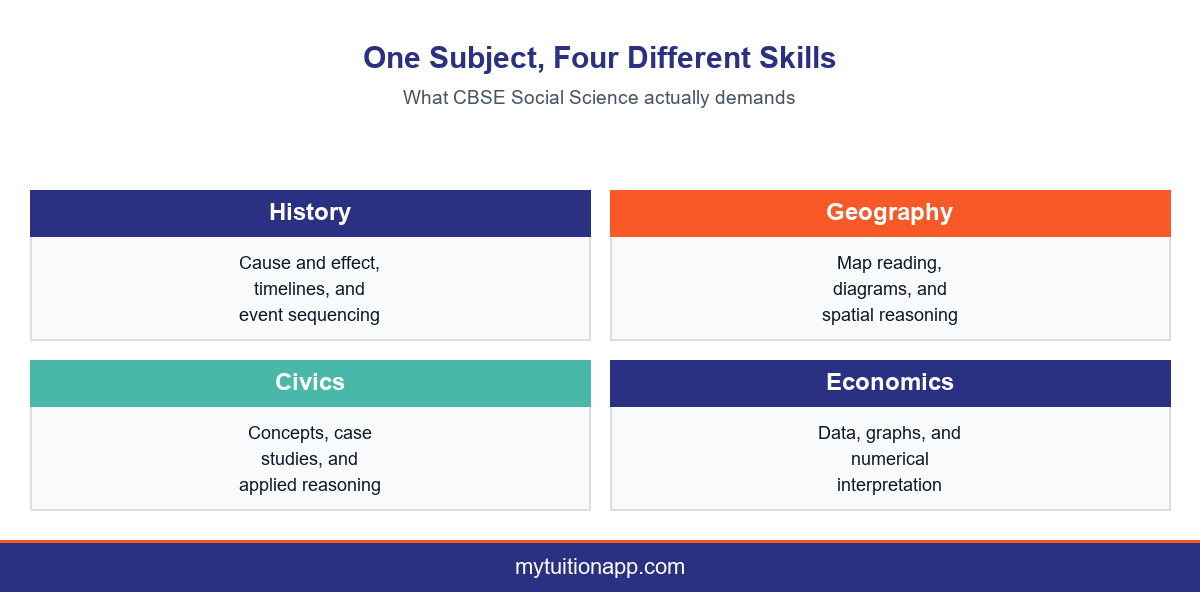
Treating Social Science as one subject to read and remember misses something important. History, Geography, Civics, and Economics each test a genuinely different kind of thinking.
History rewards a student who can explain cause and effect and sequence events correctly, not just recall dates. Geography leans heavily on map reading and spatial reasoning. Reading a textbook passage alone does not build these skills. Civics deals with constitutional and political concepts that are often abstract for a school age student. These genuinely benefit from concrete examples and case studies, rather than definitions alone. Economics introduces data, graphs, and basic numerical reasoning. This is a different mental mode entirely from the other three, closer to a Maths skill than a Social Science one. A revision method that works for History rarely works as well for Economics. This is part of why students who feel confident in one section can still struggle in another within the same subject.
Where Students Actually Struggle
The most common mistake in Social Science preparation is re reading notes repeatedly. This replaces actively practising the specific skill each section actually tests.
A student preparing for a History question on the causes of a historical event by re reading the chapter several times faces a common problem. They often walk into the exam able to recognise the content, but unable to structure an organised, cause and effect answer under time pressure. The same pattern shows up in Geography. A student who has read about a region without practising map based questions struggles when asked to actually locate or label something. Economics data questions expose this gap even more directly. No amount of reading prepares a student to interpret a graph or table they have not practised working with directly.
Civics carries a slightly different problem. Constitutional concepts like federalism or the separation of powers can sound abstract. A student can memorise a textbook definition without genuinely understanding what it means in practice. This becomes obvious the moment a question asks for an applied example, rather than a definition.
This gap between recognising content and being able to reproduce it under exam conditions is easy for a parent to miss entirely. A student’s answers in casual conversation about what they studied often sound confident and accurate. The difference only shows up in a written, timed answer. That is exactly the format a board exam actually uses, and exactly the format most independent revision never really tests until the exam itself.
How Chapter Based Tuition Handles a Text Heavy Subject Differently
The Personalised Chapter Model applies the same structured pacing to Social Science that it applies to Maths and Science. It does not leave a text heavy subject to independent revision.
Sessions do not treat a History or Civics chapter as something to read once and move past. Instead, they build in active recall. A student explains a cause and effect chain, or a constitutional concept, out loud, rather than simply rereading it silently. Geography sessions include actual map practice rather than passive review. Economics sessions work directly with sample data and graphs, so a student builds the interpretation skill the subject actually tests. This mirrors the same reasoning behind why chapter wise learning beats last minute exam prep in Maths and Science. It applies here to a subject where cramming is especially ineffective. Much of Social Science depends on structured explanation rather than raw recall.
What Personalised Social Science Tuition Looks Like Week to Week
Weekly sessions are paced by chapter and subject area. A student spends more time on whichever of the four sections is genuinely difficult. There is no equal, fixed amount of time on all four.
A student who finds Economics data questions difficult, but manages History comfortably, spends proportionally more session time on Economics. This differs from working through a fixed curriculum that assumes every student needs equal time across all four sections. This is the core benefit of the Personalised Chapter Model applied to Social Science specifically. The subject’s four way split makes an equal time approach particularly inefficient, compared with single skill subjects like Maths.
Parents also get regular, specific updates on which of the four sections a session actually covered. This differs from a general note that Social Science was taught that week. The distinction matters. It lets a parent see, for example, that Geography map work has had three sessions while Economics has had only one. They can then raise that gap directly, rather than assuming even coverage is happening by default.
Treat Social Science as Four Skills, Not One Subject
Online social science tuition for CBSE students works best when it stops treating History, Geography, Civics, and Economics as one subject to read and remember. Instead, it should build the specific skill each one actually tests. Chapter based pacing lets a student spend real time on whichever section is genuinely difficult. It does not spread an equal amount of time across all four, regardless of need. Regular parent updates make it clear exactly which sections have actually been covered in a given week. Book a free demo class to see how this approach works for your child’s specific Social Science gaps.
Frequently Asked Questions
What subjects are included in CBSE Social Science?
CBSE Social Science combines History, Geography, Civics (Political Science), and Economics into one subject. Each is tested through a different style of question in the exam paper.
Why do students struggle with Social Science despite reading regularly?
Re reading notes builds recognition, not the specific skills each section tests. Cause and effect reasoning in History, or data interpretation in Economics, need active practice instead.
Is Geography mostly about memorising place names?
No. Geography depends heavily on map reading and spatial reasoning. These skills develop through practising map based questions, rather than memorising names from a textbook alone.
Why does Civics feel harder than the other Social Science sections?
Civics deals with abstract constitutional concepts that are easy to memorise as definitions but harder to apply. This is why concrete examples and case studies matter more here than elsewhere.
Does online social science tuition help with Economics data questions specifically?
Yes. Sessions work directly with sample graphs and data tables, so a student builds interpretation skills through practice. Reading alone does not prepare a student for data based questions.
At what class does CBSE Social Science become significantly harder?
The jump is most noticeable from Class 9 onward. Economics introduces data interpretation, and Civics introduces more abstract constitutional concepts than earlier classes.
How is chapter based Social Science tuition different from a fixed weekly class?
Time is allocated based on which of the four sections a student actually struggles with. It does not spend an equal, fixed amount of time on History, Geography, Civics, and Economics regardless of need.
Can Social Science tuition be combined with Maths and Science tuition?
Yes. Our fees and formats checklist explains how subjects are combined under one plan. It also covers how batch size and format affect overall cost across subjects.
Why is active recall better than re reading for History preparation?
Explaining a cause and effect chain out loud forces a student to structure an answer the way an exam expects. Re reading only builds passive recognition of the content.
Does personalised tuition help students who feel confident in some Social Science sections but not others?
Our guide on why CBSE students lose interest in traditional coaching covers this pattern. A fixed, one size approach often fails students with uneven strengths across a subject like Social Science.