

Online biology tuition for CBSE Class 10 tends to get less attention than Physics or Chemistry. Yet it carries the same weight in the board exam. It is often the subject where marks are lost to messy diagrams, rather than genuine gaps in understanding. Parents comparing tuition options usually ask detailed questions about Physics numericals or Chemistry equations. They rarely ask how a programme handles Biology diagram practice at all. This guide looks at which Class 10 Biology chapters demand the most diagram practice. It covers where students typically lose marks, and how chapter based online tuition helps close those gaps before the board exam.
Key Takeaways
- CBSE Class 10 Biology is diagram heavy in specific chapters, and labeling errors cost more marks than most students realise.
- Chapters like Life Processes and Control and Coordination need repeated diagram practice, while Our Environment rewards clear conceptual answers.
- A chapter based tuition model lets a student spend extra time on diagram heavy chapters without falling behind on the rest of the syllabus.
Why Biology Gets Overlooked Next to Physics and Chemistry
Biology is often treated as the easier half of Class 10 Science. This leads students to under practice the diagram work that actually determines a large share of their marks.
Parents searching for Class 10 Science tuition often focus conversations on Physics numericals or Chemistry equations, since those feel more obviously difficult. Biology, by comparison, looks like a subject a student can simply read and remember. In practice, Biology diagrams, labeling accuracy, and precise NCERT wording carry real marks. These are easy to lose through small, avoidable mistakes, rather than a lack of understanding. A tuition programme that treats Biology as an afterthought to Physics and Chemistry usually leaves this gap unaddressed until very close to the exam.
This pattern shows up clearly once a student starts attempting previous year board papers. A student who scores well on chapter tests can still drop several marks on a board level paper. Chapter tests often leave diagrams optional, or only lightly checked. A board paper expects a fully labeled diagram alongside a written explanation. The gap only becomes visible when someone actually reviews a student’s diagram work. It gets checked against what a board examiner is trained to look for. This rarely happens in a self study routine focused mainly on reading and revising text.
The Chapters That Actually Need Diagram Practice
Not every Class 10 Biology chapter is equally diagram heavy. Knowing which ones are helps a student prioritise practice time correctly.
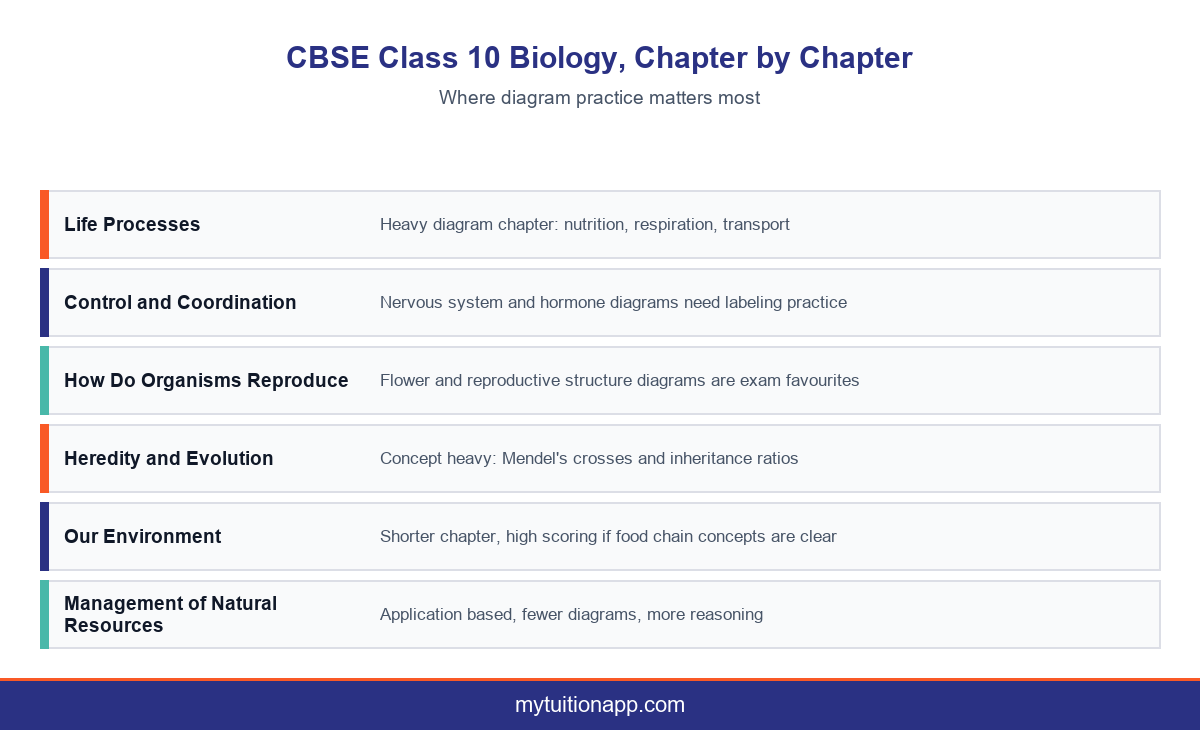
Life Processes and Control and Coordination are the two chapters where diagram accuracy matters most. They cover the human digestive system, the nervous system, and hormone pathways. All of these appear regularly in board papers as labeling or structure based questions. How Do Organisms Reproduce adds flower and reproductive structure diagrams to the mix. Heredity and Evolution is less about diagrams, and more about correctly working through Mendel’s cross ratios. Our Environment and Management of Natural Resources, by contrast, are shorter, more concept based chapters. Clear reasoning matters more than drawing accuracy here, and a well prepared student can pick up marks relatively quickly.
A useful way to plan revision time is to treat these six chapters as two groups, rather than one long list. Life Processes, Control and Coordination, and How Do Organisms Reproduce belong in a diagram heavy group. This group needs repeated drawing practice spread across several weeks, not crammed into the final days before the exam. Heredity and Evolution, Our Environment, and Management of Natural Resources sit in a second group, where written explanation and reasoning matter more. A student can often improve scores quickly here, with focused revision much closer to the exam date.
Where Students Actually Lose Marks
Most Biology marks are lost to incomplete labeling, imprecise NCERT wording, or diagrams left unlabeled under exam time pressure. It is rarely a genuine lack of understanding.
A student can understand exactly how the human digestive system works. They can still lose marks for a diagram missing two labels. The same happens when describing a process in casual language, instead of the specific terms CBSE examiners expect. This gap sits between understanding a concept and reproducing it precisely under exam conditions. It is one of the most common, and most fixable, sources of lost marks in Class 10 Biology. It rarely shows up in a student’s own self assessment, since they genuinely know the material. This is why an outside check on written answers matters as much as the initial teaching.
Time pressure makes this worse. A student who can draw a perfect, fully labeled diagram of the human eye, given unlimited time, may still rush and skip two labels. The same diagram has only a few minutes in a real board paper. Practising diagrams under a timer, not just practising them accurately, is what closes this specific gap. It is a step most self study routines skip entirely.
How Chapter Based Tuition Helps Close These Gaps
A chapter based tuition model gives a student the extra repetition a diagram heavy chapter needs. It does not slow down progress through the rest of the Biology syllabus.
Under the Personalised Chapter Model, a student spends additional guided time on Life Processes or Control and Coordination specifically. Redrawing and relabeling diagrams continues until accuracy becomes automatic. Meanwhile, a shorter chapter like Our Environment moves at a faster pace once the concepts are clear. This is a direct extension of the same online science tuition for Class 10 approach applied across Physics and Chemistry. It adapts to what Biology specifically requires: repeated, checked diagram practice, rather than just concept explanation.
This pacing is chapter based, not tied to a fixed weekly timetable. A student who needs a third or fourth pass at labeling the human eye or the nephron simply gets it. There is no need to wait for the rest of a batch to move on first. Diagrams are also checked individually during sessions, rather than left for a student to self assess. This is where most labeling mistakes actually get caught. It happens early enough to fix before the board exam, rather than during it.
Where Biology Sits in the Overall Class 10 Science Paper
Biology carries roughly a third of the total Class 10 Science marks. That makes it too significant to treat as a lighter subject, compared with Physics and Chemistry.
CBSE combines Physics, Chemistry, and Biology into a single Science paper for Class 10. Biology’s share of that paper is close to Physics and Chemistry individually, not a smaller afterthought. A student who under prepares Biology because it feels less technical is giving up marks. That section is worth roughly as much as either of the other two subjects. Treating all three with the same structured, diagram checked preparation tends to produce a more even, and ultimately higher, overall Science score. This beats focusing revision time unevenly toward whichever subject feels hardest on paper.
Biology Deserves the Same Attention as Physics and Chemistry
Online biology tuition for CBSE Class 10 works best when it treats diagram accuracy and precise NCERT wording as seriously as concept explanation. That is where most marks are actually lost. Chapter based pacing lets a student spend the extra time diagram heavy chapters demand, without losing ground elsewhere in the syllabus. Shorter, concept driven chapters move at a faster pace once they are genuinely understood. The result is a more even score across all three Science subjects, rather than one subject quietly dragging the overall total down. Book a free demo class to see how this works for your child’s specific gaps in Biology.
Frequently Asked Questions
Which CBSE Class 10 Biology chapters need the most diagram practice?
Life Processes and Control and Coordination require the most diagram practice. They cover the digestive system, nervous system, and hormone pathways, all common sources of labeling based board exam questions.
Why do students lose marks in Biology despite understanding the concepts?
Marks are commonly lost to incomplete diagram labeling or imprecise wording, rather than a lack of understanding. CBSE examiners expect specific terminology and complete, accurate diagrams.
Is Biology easier than Physics and Chemistry in CBSE Class 10?
Not necessarily. Biology is often treated as easier, since it involves less calculation. But diagram accuracy and precise answer writing carry marks that are just as easy to lose through inattention.
How many chapters are in CBSE Class 10 Biology?
CBSE Class 10 Biology covers six chapters. These are Life Processes, Control and Coordination, How Do Organisms Reproduce, Heredity and Evolution, Our Environment, and Management of Natural Resources.
What does chapter based online biology tuition actually look like?
A student spends extra guided time on diagram heavy chapters like Life Processes. Redrawing and relabeling diagrams continues until accuracy is consistent, while moving faster through shorter, concept based chapters.
Does Heredity and Evolution require diagram practice like other chapters?
Less so. Heredity and Evolution focuses more on correctly working through Mendel’s cross ratios and inheritance patterns. This differs from the diagram labeling emphasis in Life Processes or Control and Coordination.
How is online biology tuition different from just reading NCERT textbooks alone?
Guided tuition checks a student’s actual written diagrams and answers against what examiners expect. This catches labeling gaps or imprecise wording that self study alone rarely surfaces in time.
Can online biology tuition be combined with Physics and Chemistry tuition?
Yes. Our Class 10 Chemistry tuition guide covers this. The same chapter based approach applies across all three Science subjects together, under one programme.
What is the best way to prepare Our Environment for the board exam?
Our Environment rewards clear conceptual answers on food chains and ecosystems more than diagram accuracy. This makes it one of the faster chapters to prepare well, relative to its scoring weight.
How can parents check pricing and format before starting Biology tuition?
Our fees and formats checklist explains batch sizes, session formats, and costs across subjects. It covers how Biology tuition fits alongside Physics and Chemistry in one combined plan.