

From Dubai to Manama, Indian families across the Gulf Cooperation Council face a common challenge: keeping children on the CBSE syllabus while living outside India. cbse tuition for indians in gcc families rely on has to solve for six different school systems, six different time zones, and one shared goal. This is how 90+ does it from a single platform.
Key Takeaways
- 90+ runs live CBSE tuition in all six GCC countries: UAE, Qatar, Saudi Arabia, Kuwait, Oman and Bahrain.
- Every country’s classes are scheduled around local evening hours, not a single fixed Indian time slot.
- The same Personalised Chapter Model and Double Power verification apply everywhere, so the experience is consistent no matter where a family is based.
Why NRI Families Across the GCC Face the Same Core Problem
Whether a family is in Dubai, Doha, Riyadh, Kuwait City, Muscat or Manama, the underlying challenge is nearly identical. Indian curriculum school seats are limited relative to demand, class sizes at the schools that do exist are often large, and many families end up in international curriculum schools locally while still wanting their child prepared for CBSE.
That is the exact gap online tuition for nri students cbse is meant to close, and it is why 90+ built one consistent platform rather than six separate country specific products. A parent moving from Dubai to Doha for work does not need to start over with a new tuition provider.
One Platform, Six Countries: How 90+ Actually Works Across the GCC
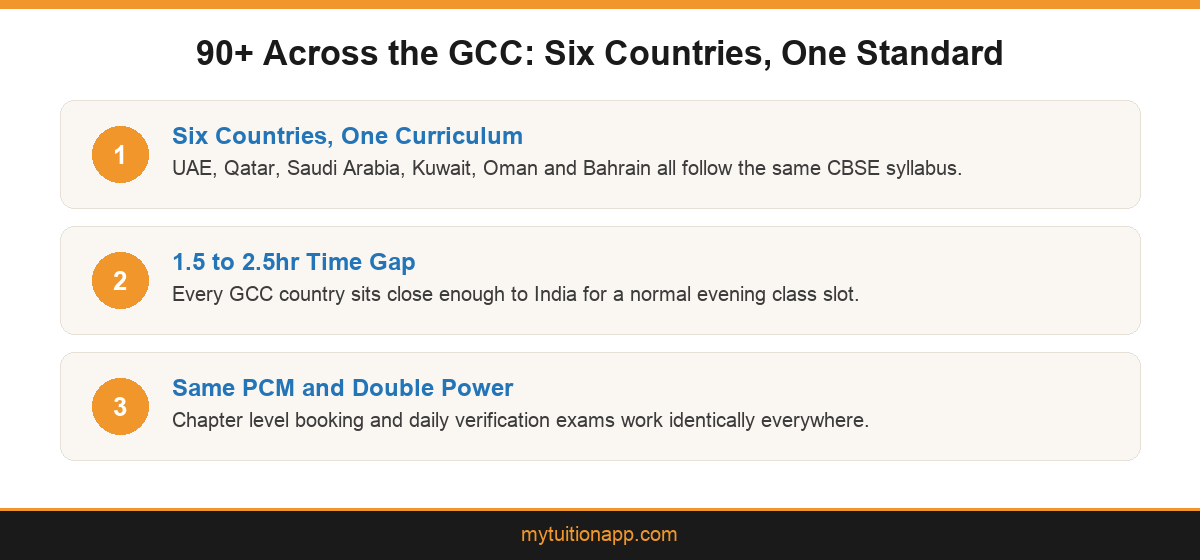
90+ currently teaches Indian students in the UAE, Qatar, Saudi Arabia, Kuwait, Oman and Bahrain. Every country sits between 1.5 and 2.5 hours behind Indian Standard Time, close enough that live classes fit into a normal after school evening slot no matter which of the six a student calls home.
The curriculum does not change from country to country either. Every student, regardless of location, follows the same current CBSE syllabus and NCERT textbooks used across India, so a family relocating within the GCC for work does not have to reconcile two different versions of what their child has already learned.
The PCM and Double Power Difference for GCC Families
Across all six countries, the Personalised Chapter Model works the same way. Instead of a fixed weekly package for an entire subject, a family books only the specific chapters their child needs, whether that is one topic in Physics for a student in Muscat or three chapters of Maths for a student in Riyadh.
Double Power Tuition then layers daily short exams and written assessments on top of every chapter, everywhere 90+ operates. That means a parent in any GCC country gets the same verified, chapter level proof of learning, not a system that varies in quality depending on which country a family happens to be posted in.
Finding the Right Country Guide for Your Family
Each GCC country has its own local school landscape, time zone offset and Indian community context worth understanding before enrolling. 90+ has published a dedicated guide for each: UAE and Dubai, Qatar, Saudi Arabia, Kuwait, Oman and Bahrain.
Families who need Maths and Science covered together, rather than one subject at a time, can also look at 90+’s tuition built specifically for NRI students trying to stay chapter aligned with the CBSE syllabus while abroad.
Why a Single Regional Platform Beats a Country by Country Search
Most families searching for CBSE support abroad start over every time their circumstances change. A posting moves a family from Dubai to Doha, or a relative recommends a Riyadh based tutor who cannot help once the family relocates to Kuwait. Each move means researching a new local provider from scratch, with no guarantee of the same teaching quality or CBSE alignment.
A single platform operating consistently across the region removes that repeated search. A family that starts with 90+ in the UAE and later relocates to Bahrain does not need to vet a new provider, negotiate a new arrangement, or hope the replacement teaches to the same CBSE standard. The chapters a student has already completed, and the ones still pending, carry over cleanly.
This also means a large family with children in different GCC countries, a common situation among Indian expat households with relatives spread across the Gulf, can standardise on one system rather than managing several unrelated tutoring arrangements with different pacing, different teachers and different reporting standards.
Who This GCC Programme Is Actually Built For
Three types of families make up most of 90+’s GCC student base. The first is parents whose children attend a British, American or IB curriculum school locally but want to keep CBSE as a live option, whether for a future return to India or simply to broaden university choices later.
The second is families already at a CBSE affiliated school abroad who find the classroom pace too fast or too slow for their specific child in one or two subjects, and want targeted support rather than a generic after school programme repeating the same material.
The third is families anticipating a move, either back to India or to another GCC country, who want their child’s syllabus current and verified before that transition happens, rather than discovering a gap after the move is already underway. The country specific guides above cover the details relevant to each of these situations by location.
What This Means for Board Exam Years Across the GCC
Class 10 and Class 12 board years carry the highest stakes of any point in a student’s CBSE journey, and they are also when the cost of unaddressed syllabus gaps becomes hardest to absorb. A family in any of the six GCC countries facing a board year benefits from the same PCM and Double Power structure, just applied with more urgency and a tighter chapter by chapter timeline.
90+ treats board exam preparation as an extension of the regular chapter model rather than a separate crash course bolted on at the last minute. Students who have used PCM consistently through Class 9 typically enter Class 10 with far fewer gaps to close under exam pressure than students starting cold.
For families anywhere in the GCC beginning board preparation later than ideal, 90+’s dedicated study plan for scoring well in CBSE Class 10 boards outlines a structured path that works alongside PCM’s chapter specific sessions, regardless of which of the six countries a student is based in.
This consistency also matters for families comparing notes across the GCC, something that happens often within extended Indian families with relatives in more than one Gulf country. A cousin in Dubai and a cousin in Manama going through the same board year can follow an identical PCM structure, making it easier for parents to compare progress and share what is working.
For families anywhere in the six countries approaching a board year for the first time, the practical starting point is the same regardless of location: a free demo class, an honest read on which chapters need the most attention, and a PCM plan built around the months remaining before the exam rather than a generic full syllabus review.
Conclusion
Wherever your family is based across the GCC, cbse tuition for indians in gcc should not depend on which country you happen to live in. 90+’s Personalised Chapter Model and Double Power verification work the same way in Dubai, Doha, Riyadh, Kuwait City, Muscat and Manama. Book a free demo class and find your country’s guide above to get started.
Frequently Asked Questions
1. Which GCC countries does 90+ currently serve?
UAE, Qatar, Saudi Arabia, Kuwait, Oman and Bahrain, all through the same live CBSE curriculum and platform.
2. Does the tuition experience change if a family relocates within the GCC?
No. The syllabus, PCM structure and Double Power verification stay identical, so a move between GCC countries does not disrupt a child’s progress.
3. How is class scheduling handled across six different GCC time zones?
Every GCC country sits between 1.5 and 2.5 hours behind Indian Standard Time, so live classes are scheduled to fit a normal evening slot in each.
4. Is the CBSE syllabus the same across all six countries 90+ serves?
Yes. Every student, regardless of country, follows the same current CBSE syllabus and NCERT textbooks used across India.
5. What is the Gulf Cooperation Council, and does it affect how 90+ operates?
The Gulf Cooperation Council is a regional bloc of six member states. 90+ operates independently in each based on local demand, not GCC policy.
6. Can a family compare country specific details before choosing to enrol?
Yes. Each country has its own dedicated guide covering local school context, time zones and enrolment details specific to that market.
7. Does 90+ offer combined Maths and Science tuition for GCC based NRI students?
Yes. A dedicated NRI focused programme covers Maths and Science together for students staying aligned with India’s syllabus.
8. How does Double Power Tuition work the same way across all six countries?
Every chapter, in every country, includes short exams and written assessments, so verification standards do not vary by location.
9. Is a free demo class available regardless of which GCC country a family is in?
Yes. Families anywhere across the six countries can book a free demo class before enrolling for a full term.
10. Does moving from one GCC country to another require re enrolling from scratch?
No. Because the platform, syllabus and PCM structure are identical everywhere, a relocating family can continue with minimal disruption.