

Online Hindi tuition for CBSE students is often the last subject a family considers, usually because Hindi feels manageable next to Maths and Science. CBSE Hindi still tests three genuinely different skills, vyakaran, rachna and sahitya, and treating all three as one subject to read and revise is exactly why otherwise capable students plateau in Hindi despite putting in real effort. This guide breaks down what each part actually demands and how chapter based tuition helps close the specific gaps that matter.
Key Takeaways
- CBSE Hindi tests grammar, writing and literature as three distinct skills, not one general subject to read and remember.
- Marks are commonly lost to applied grammar errors and shallow literature answers, not a lack of vocabulary.
- Chapter based tuition treats Hindi with the same structured pacing as Maths or Science, rather than leaving it to independent reading.
Why Hindi Gets Even Less Attention Than English
Hindi is frequently treated as the subject requiring the least outside support, since most CBSE students already understand spoken Hindi comfortably from home or their surroundings.
This assumption causes families to deprioritise Hindi tuition even more readily than English, since a child who understands Hindi conversation is assumed to be fine academically as well. Written CBSE Hindi, particularly from Class 9 onward, expects considerably more than comprehension. Applied vyakaran rules, structured rachna formats for letters and essays, and analytical answers on sahitya passages from textbooks like Kshitij and Sparsh are skills a student does not pick up simply from speaking Hindi at home.
Because Hindi rarely triggers the same concern a falling Maths or Science score does, a genuine gap in Hindi often stays unaddressed the longest of any subject, surfacing only when a report card shows a lower score than a family expected.
This pattern is not unique to Hindi. It mirrors what happens with English tuition in many CBSE households, where spoken comfort in a language is mistaken for exam readiness. Even in states where Hindi is not the primary language spoken at home, students often pick up enough conversational Hindi from school and media that the same false sense of readiness sets in, masking a written skill gap that only shows up once exam level answers are actually expected.
Vyakaran, Rachna, and Sahitya
CBSE Hindi is tested across three distinct areas, each requiring a different kind of preparation rather than general reading and revision.
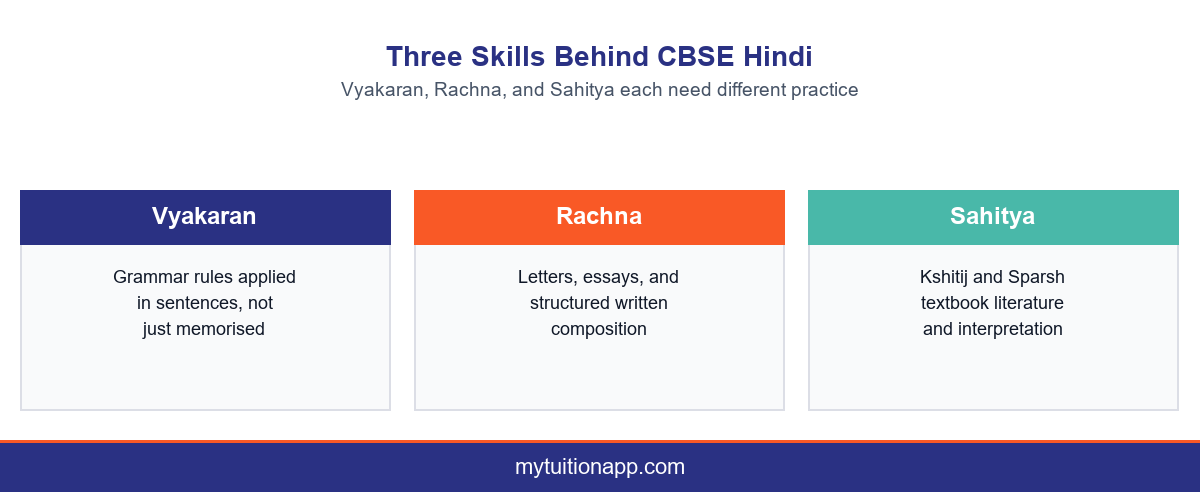
Vyakaran, or grammar, tests applied rules such as sandhi, samas, and correct sentence construction under exam conditions, not just recognition of a rule when it is explained in isolation. Rachna covers structured writing, including formal letters, essays, and notices, each expecting a specific format that CBSE examiners check closely, similar in spirit to the format expectations in CBSE English writing. Sahitya, the literature component built around textbooks like Kshitij and Sparsh, asks a student to interpret a poem or prose passage analytically rather than simply summarise its content. A student comfortable speaking Hindi can still be genuinely weak in any one of these three areas, which is why broad revision rarely moves the needle on its own.
These three areas also build on each other in a specific order, similar to the pattern seen in English. Grammar accuracy supports writing, since a well structured essay full of grammatical errors still loses marks, and writing practice in turn supports literature answers, since analytical responses are themselves a form of structured writing. A student weak in one area often shows related weaknesses in the other two, even when the underlying issue traces back to just one of the three.
Where CBSE Hindi Marks Are Actually Lost
Applied grammar errors inside longer answers and shallow literature interpretation are the two most common sources of lost marks in CBSE Hindi.
A student can correctly identify a grammar rule when it is asked about directly, then apply it incorrectly inside a full paragraph where several rules overlap at once, which is a very different and considerably harder skill than isolated grammar recognition. Sahitya answers face a related problem, where a student accurately describes what happens in a poem or story without engaging with tone, symbolism, or the writer’s intent, producing a technically correct but genuinely weaker answer than what CBSE examiners are looking for.
Rachna format errors are the most mechanically fixable of the three, yet still cost marks consistently. A well written formal letter missing the correct salutation or subject line format loses marks regardless of how strong the Hindi itself is, purely on a structural technicality that is straightforward to correct once identified.
Vyakaran loses marks in a quieter, more persistent way than either of the other two areas. A student can answer a standalone grammar question correctly, then make the same error repeatedly across a full essay without noticing, since nothing in a rachna or sahitya answer explicitly flags the mistake as a grammar problem rather than simply a lower quality answer overall.
How Chapter Based Tuition Handles Hindi Differently
The Personalised Chapter Model applies the same structured pacing to Hindi that it applies to Maths and Science, treating vyakaran, rachna, and sahitya as three separate tracks rather than one subject.
A student weak specifically in applied grammar spends more session time working through full paragraph exercises rather than isolated rule drills, while a student struggling with sahitya interpretation practises analysing unfamiliar passages rather than re reading ones already covered in class. Our guide on how chapter wise learning beats last minute exam prep explains the same underlying mechanism, and it applies just as directly to Hindi, where cramming grammar rules or literature summaries the night before an exam rarely produces consistent, applied accuracy.
What This Looks Like Week to Week
Weekly sessions are paced by which of the three Hindi skill areas a student actually needs the most support with, rather than a fixed rotation through grammar, writing, and literature regardless of need.
A student close to strong in sahitya but weak on rachna format spends more time on structured letter and essay practice specifically, with actual written work reviewed each week rather than general Hindi revision that touches all three areas lightly. Parents receive the same regular, chapter level updates used across other subjects, making it clear which specific Hindi skill was actually covered in a given week.
Written work is corrected directly during sessions rather than only discussed verbally, since an actual essay or grammar exercise reveals patterns a spoken explanation of the same rule tends to hide. Over several weeks, this repeated, specific correction is what turns an occasionally strong Hindi answer into a consistently strong one across all three skill areas.
Hindi Deserves the Same Structure as Any Other CBSE Subject
Online Hindi tuition for CBSE students works best when it stops assuming spoken fluency is enough and instead treats vyakaran, rachna, and sahitya as three distinct skills, each needing focused, chapter based practice. This mirrors the same approach that works for our English tuition programme, applied here specifically to Hindi. Book a free demo class to see how this works for your child’s specific Hindi gaps.
Frequently Asked Questions
Does speaking Hindi fluently mean a CBSE student does not need Hindi tuition?
Not necessarily. Spoken fluency does not guarantee strong applied grammar, structured writing, or literature analysis skills, which are tested separately and specifically in CBSE Hindi.
What are the three main areas tested in CBSE Hindi?
CBSE Hindi tests vyakaran (grammar), rachna (structured writing like letters and essays), and sahitya (literature from textbooks like Kshitij and Sparsh), each needing different preparation.
Why do students lose marks in Hindi grammar despite knowing the rules?
Marks are often lost when applying a known grammar rule correctly inside a longer paragraph with several overlapping rules, which is harder than recognising the rule in isolation.
What is the difference between CBSE Hindi A and Hindi B?
Hindi A and Hindi B are offered from Class 9 onward, with Hindi A generally involving more advanced literature content, though both test the same three skill areas of grammar, writing, and literature.
How is a strong sahitya answer different from a technically correct one?
A strong answer analyses tone, symbolism, or the writer’s intent, while a weaker one only summarises the passage’s content without engaging with what the question is actually asking.
Does online Hindi tuition help with formal letter and essay formatting?
Yes. Rachna sessions focus specifically on correct format, such as salutations and subject lines, which are common, easily fixable sources of lost marks in otherwise well written answers.
How is chapter based Hindi tuition different from general revision?
Session time is allocated based on which of the three skill areas, grammar, writing, or literature, a student actually needs the most support with, rather than covering all three equally.
Can Hindi tuition be combined with English tuition in the same plan?
Yes. Our English tuition guide explains how a similar three skill structure applies to English, and both subjects can be combined under one chapter based plan.
At what class should a family start paying closer attention to CBSE Hindi?
Class 9 onward is when written expectations increase significantly, since Hindi A and B introduce more demanding literature and writing requirements than earlier classes.
How can parents compare pricing and format for Hindi tuition?
Our fees and formats checklist explains batch sizes, session formats, and costs, which apply the same way to Hindi as to other CBSE subjects.