

Online English tuition for CBSE students is usually the last subject a family arranges, if they arrange it at all. English feels like a subject a child already knows, simply by speaking it every day. CBSE English is not tested that way. Grammar, writing, and literature each demand a distinct, structured skill that everyday conversation does not build on its own. This guide breaks down what each part of the CBSE English paper actually requires. It covers where students commonly lose marks, and how chapter based tuition helps close those specific gaps.
Key Takeaways
- Fluency in spoken English does not automatically translate into strong CBSE grammar, writing, or literature answers.
- Grammar, writing, and literature are tested as three distinct skills, each needing its own kind of practice.
- Chapter based tuition applies the same structured pacing to English that it applies to Maths and Science, rather than leaving it to independent reading.
Why English Rarely Gets Tuition Attention
A child who speaks English comfortably at home or school is often assumed to be fine in the subject academically. This is not always true.
Spoken fluency and exam level English are genuinely different skills. A student can hold a completely natural conversation in English and still lose marks on a grammar based fill in the blanks question. They might also write an essay that reads casually, rather than in the structured format a CBSE examiner expects. This gap is not obvious from daily conversation. English is frequently the subject where a real weakness goes unnoticed the longest. Neither the student nor the parent gets an obvious signal that something needs attention, until a report card shows it directly.
This also means English tuition is rarely requested proactively. Families tend to arrange it reactively, after a disappointing exam result. It rarely gets planned from the start, alongside Maths and Science, as part of a child’s overall CBSE preparation.
There is also a comparison problem specific to English. A parent can look at a Maths test and see exactly which question was answered incorrectly. An English essay or literature answer is harder to evaluate, without training in what CBSE examiners are actually looking for. This makes it genuinely difficult for a family to judge, on their own, whether a child’s English work is strong, average, or quietly slipping. It is another reason the subject often gets less structured attention than it deserves.
Three Skills Behind One Subject
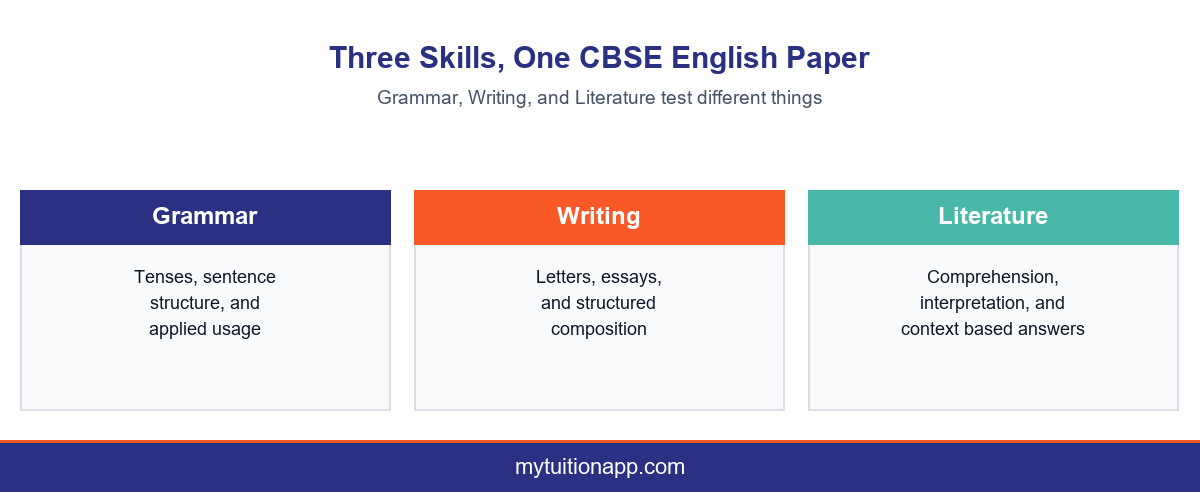
CBSE English tests grammar, writing, and literature as three separate skills within a single paper. Strength in one does not guarantee strength in the others.
Grammar tests applied usage, such as correct tense, sentence structure, and voice, under exam conditions rather than casual speech. In casual speech, small errors are usually overlooked entirely. Writing covers structured composition, including formal letters, essays, and notices. Each has a specific format CBSE examiners expect a student to follow precisely, not just write about clearly. Literature asks a student to interpret a passage or poem within its context and answer analytically. This is a skill closer to reading comprehension under time pressure than general reading ability. A student strong in conversational English can still be weak in any one of these three areas specifically. This is why a single, general approach to English revision often fails to move the needle.
It also helps to think of these three areas as building on each other in a specific order. Grammar accuracy supports writing, since a well structured essay full of tense errors still loses marks. Writing practice, in turn, supports literature answers, since analytical answers are themselves a form of structured writing. A student with a genuine grammar gap will often show writing and literature weaknesses too. Often, the underlying issue is really just one of the three areas left unaddressed.
Where Marks Are Actually Lost in Writing and Literature
Format errors in writing, and shallow interpretation in literature, are the two most common sources of lost marks in CBSE English. Both are also the most avoidable.
A formal letter or essay written with genuinely good English can still lose marks for missing the specific format CBSE expects. Examples include an incorrect salutation, a missing subject line, or a paragraph structure that does not match what the question requires. This is a mechanical, fixable issue, not a sign of weak English ability. It costs marks consistently, though, until someone specifically corrects the format habit. Literature answers face a related problem. A student summarises a passage’s content accurately, without actually analysing the tone, context, or the writer’s intent the question is asking about. That gap is the difference between a surface level answer and a genuinely strong one.
Grammar loses marks in a quieter way. A student can understand a rule correctly when it is explained in isolation. They may still apply it incorrectly inside a longer passage, where several grammar concepts overlap at once. This is why grammar exercises done in isolation, one rule at a time, often do not transfer well. A full length written answer needs several rules applied correctly and simultaneously, under time pressure.
How Chapter Based Tuition Handles Grammar, Writing and Literature Differently
The Personalised Chapter Model treats grammar, writing, and literature as separate tracks within English. It does not treat English as one general subject to revise all at once.
A student weak specifically in essay format spends more session time on writing structure and practice letters. A student who struggles with literature analysis instead gets more guided practice interpreting unfamiliar passages, rather than re reading ones already covered in class. This same logic already applies to why chapter wise learning beats last minute exam prep in Maths and Science. It applies just as directly to English. Cramming grammar rules the night before an exam rarely produces the consistent, applied accuracy that scoring well actually requires.
What This Looks Like for a Student Week to Week
Weekly sessions are paced by which of the three English skill areas a student actually needs the most support with. There is no fixed rotation through grammar, writing, and literature regardless of need.
A student close to strong literature answers but weak on formal letter format spends more time practising letters specifically. Actual written work gets reviewed and corrected each week. This differs from general English revision that touches all three areas lightly, without fixing any of them thoroughly. Parents receive the same regular, chapter level updates used across other subjects. This makes clear which specific skill area was covered, rather than a vague note that English was taught that week.
Written work is corrected directly, rather than only discussed verbally. A student’s actual essay or letter reveals format and grammar habits that a spoken explanation of the same rule often hides. Over several weeks, this repeated, specific correction turns an occasionally strong answer into a consistently strong one. That is the pattern CBSE examiners actually reward across a full exam paper.
English Needs the Same Structure as Any Other CBSE Subject
Online English tuition for CBSE students works best when it stops assuming spoken fluency is enough. It should instead treat grammar, writing, and literature as three distinct skills, each needing its own focused practice. Chapter based pacing lets a student spend real time on whichever of the three areas is genuinely weak. It corrects fixable issues, like letter format or shallow literature analysis, before they cost marks repeatedly. Book a free demo class to see how this approach works for your child’s specific English gaps.
Frequently Asked Questions
Does speaking English fluently mean a CBSE student does not need English tuition?
Not necessarily. Spoken fluency and exam level grammar, writing format, and literature analysis are different skills. A fluent speaker can still lose marks in any of the three specifically.
What are the three main skill areas tested in CBSE English?
CBSE English tests grammar, writing (letters, essays, and notices), and literature comprehension and analysis. Each requires a different kind of preparation and practice.
Why do students lose marks in formal letters despite good English?
Marks are commonly lost to format errors, such as a missing salutation or incorrect paragraph structure, rather than weak language skills. These are usually easy to fix once identified.
What makes a literature answer strong rather than just accurate?
A strong answer analyses tone, context, and the writer’s intent. A weaker one only summarises the passage’s content, without engaging with what the question is actually asking.
How is online English tuition structured differently from general revision?
Session time is allocated based on which specific skill, grammar, writing, or literature, a student actually needs the most support with. It does not cover all three equally regardless of need.
At what class should CBSE English tuition start?
There is no fixed class, since gaps can appear at any stage. Catching weak areas early, particularly before Class 9 and 10, makes them easier to correct before board exam pressure builds.
Is grammar cramming effective right before a CBSE English exam?
Not usually. Applied grammar accuracy under exam conditions tends to come from consistent, spaced practice. Reviewing rules quickly in the days before an exam rarely works as well.
Why do families often arrange English tuition later than Maths or Science?
Our guide on why CBSE students lose interest in traditional coaching covers this pattern too. Subjects without an obvious daily struggle, like English, often get deprioritised until a report card reveals a gap.
Can English tuition be combined with Maths and Science tuition in one plan?
Yes. Our fees and formats checklist explains how multiple subjects, including English, combine under one plan. It also covers how that affects overall cost and session format.
How can a parent tell if their child has a genuine English gap?
A report card showing lower marks specifically in writing or literature sections is usually the clearest early signal worth acting on. This matters especially if spoken English at home is comfortable.