
A student who spends two or three years at an international curriculum school abroad can drift quietly away from the CBSE syllabus, often without a parent noticing until a return to India makes the gap obvious. online maths tuition for nri students and matching Science support exist to prevent exactly that drift. Here is how 90+ keeps NRI students chapter aligned with India, wherever they are based.
Key Takeaways
- Maths and Science are the two subjects where curriculum drift shows up fastest and hurts most at CBSE board exam time.
- 90+ teaches the same CBSE syllabus and NCERT content used in India, whether a student is in the GCC or elsewhere abroad.
- PCM lets NRI families target only the specific chapters where their child has fallen behind, rather than repeating material already covered.
Why NRI Students Fall Behind the CBSE Syllabus Abroad
Most NRI families do not plan to fall behind. A child enrols in a British, American or IB curriculum school abroad because that is what is locally available, and Maths and Science content in those systems often covers similar topics in a different order, or at a different depth, than CBSE does at the same grade.
The gap tends to surface at the worst possible moment, when a family plans to return to India for Class 10 or Class 12 boards and discovers their child is missing foundational chapters that CBSE assumes are already in place. By then, catching up under exam pressure is far harder than it needed to be.
Maths Tuition for NRI Students: Staying Chapter Aligned
Maths is cumulative in a way few other subjects are. A student who misses how quadratic equations were introduced will struggle with everything built on top of that chapter later, even if later topics are technically covered at their local school. This is where NRI students lose the most ground silently.
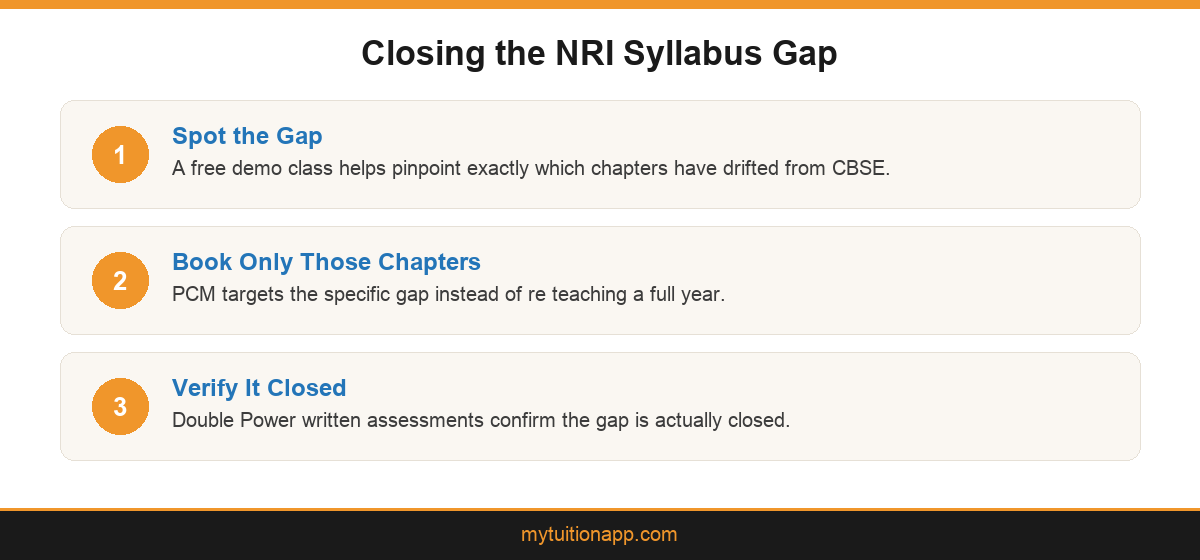
90+’s Personalised Chapter Model is particularly suited to this problem. Rather than re teaching an entire year of Maths, a family can identify the specific two or three chapters where CBSE and their local curriculum diverged and book targeted sessions only for those, closing the gap without wasting time on material the student already knows.
Science Tuition for NRI Students: Physics, Chemistry and Biology in Sync
Science drift is often subtler than Maths drift, since most curricula cover broadly similar topics. The difference tends to show up in depth and terminology, particularly in Chemistry and Physics, where CBSE’s approach to numerical problems and its NCERT derived vocabulary can differ noticeably from an international textbook’s phrasing.
90+ teaches Physics, Chemistry and Biology directly from CBSE and NCERT source material, so an NRI student is not just learning the concept generally, they are learning it the way it will actually be tested on a CBSE board exam paper, which matters more than most parents realise until exam season arrives.
How PCM and Double Power Keep NRI Students on Track
Because 90+ operates across the UAE and every other GCC country, live classes are scheduled around local evening hours rather than a fixed Indian time slot, so NRI families are not asked to disrupt their child’s normal routine to stay CBSE aligned.
Every chapter, in Maths or Science, closes with short exams and written assessments under Double Power Tuition, giving parents concrete proof a specific gap has actually closed, not just a general sense that their child attended more classes this term.
When to Start Checking for CBSE Syllabus Drift
The earliest warning signs usually appear around Grade 6 or 7, when Maths shifts from arithmetic toward algebra and geometry, and Science begins separating into distinct strands that later become Physics, Chemistry and Biology. A student whose local curriculum sequences these topics differently can build a foundation that looks fine locally but does not match what CBSE assumes by Class 9.
By Class 9 and 10, drift becomes far more visible and far more costly to fix, since board exam preparation leaves little spare time for foundational catch up. Parents who check in on syllabus alignment every year or two, rather than waiting for a specific problem to appear, catch gaps while they are still one or two chapters wide instead of a full unit or more.
A simple way to check is comparing a child’s current school topics against the CBSE syllabus published for their grade, or booking a free assessment with 90+ that maps a student’s actual knowledge against what CBSE expects at that stage, chapter by chapter rather than subject by subject.
What a Baseline Assessment Actually Involves
A baseline assessment with 90+ starts with a short, informal conversation covering which curriculum a student currently follows and which grade level CBSE content they last studied confidently, before any formal testing begins. This context alone often narrows down where a gap is likely to be.
The student then works through a small set of chapter specific questions in Maths and Science, chosen to reveal whether foundational concepts from earlier grades are solid, not just whether current topics are understood. This is deliberately different from a standard placement test, which usually only checks current grade material.
Parents receive a plain summary afterward showing exactly which chapters are strong and which need attention, forming the starting point for a PCM booking. There is no obligation to enrol after the assessment, and families are free to use the results simply to understand where their child stands against the CBSE syllabus.
How This Differs From General International Tutoring Services
Many international tutoring platforms serve NRI families with a generalist approach, offering help with whichever curriculum a student’s local school happens to follow, whether that is British, American or CBSE. That breadth is useful for general homework support but rarely goes deep enough into CBSE specific board exam requirements.
90+ takes the opposite position deliberately. Every teacher, every chapter and every assessment is built specifically around CBSE and NCERT content, which means an NRI student gets the same depth of CBSE specific preparation as a peer studying in India, not a diluted version adapted from a different curriculum.
That specialisation matters most at the two points where it is hardest to recover from a shallow approach: closing a specific syllabus gap identified through a baseline assessment, and preparing for CBSE board exams where question patterns, mark weightage and NCERT phrasing all differ meaningfully from a generalist international curriculum.
For NRI families weighing the two options, the practical test is simple. A generalist platform can usually help a student pass a test on a topic. A CBSE specific programme like 90+ is built to help a student score well on the specific CBSE exam paper that topic will eventually appear on, which is a meaningfully different and narrower target to hit.
The clearest way to see this difference is through the baseline assessment itself. A generalist tutor evaluates whether a student understands a topic in general terms. 90+’s assessment checks specifically against what a CBSE exam paper would ask, at the depth and in the format a student will actually encounter when the board exam arrives.
Conclusion
Curriculum drift is easy to miss until a report card or a return to India makes it obvious. online maths tuition for nri students and matching Science support through 90+ close that gap chapter by chapter, verified through Double Power at every step. Book a free demo class to identify exactly where your child’s syllabus has diverged.
Frequently Asked Questions
1. How can a parent tell if their NRI child has fallen behind the CBSE syllabus?
The clearest signs are struggling with topics a CBSE peer in India has already mastered, or a report card showing gaps in specific chapters, not whole subjects.
2. Does 90+ combine Maths and Science tuition, or are they taught separately?
Both options exist. Families can book combined sessions or focus on just one subject, depending on where the specific gap is.
3. Which GCC countries can access this NRI focused Maths and Science tuition?
All six: UAE, Qatar, Saudi Arabia, Kuwait, Oman and Bahrain, through 90+’s regional platform.
4. Is the Science content taught the same as an international curriculum school’s syllabus?
Not exactly. 90+ teaches Physics, Chemistry and Biology directly from CBSE and NCERT material, matched to how it appears on board exam papers.
5. Can PCM target just the chapters where drift happened, not the whole year?
Yes. The Personalised Chapter Model is built exactly for this, letting families book only specific weak chapters.
6. At what grade should NRI parents start checking for CBSE syllabus gaps?
Ideally from Grade 6 onward, since Maths especially is cumulative and small early gaps compound significantly by Class 10.
7. How does Double Power Tuition confirm a specific gap has closed?
Each chapter includes short written assessments, giving parents verified proof of understanding rather than a general sense of improvement.
8. Does time zone difference make scheduling difficult for NRI families?
No. GCC countries sit only 1.5 to 2.5 hours behind India, so live classes fit into a normal evening study slot locally.
9. Can an NRI student use this tuition to prepare for a return to an Indian CBSE school?
Yes. Staying chapter aligned throughout is exactly what makes a later transition back into an Indian classroom manageable.
10. Is there a way to identify exactly which chapters a child is behind on before enrolling?
Yes. A free demo class includes an informal assessment that helps pinpoint specific gaps before committing to a full term.