

CBSE maths coaching online is often searched for at the exact moment a family is worried. Usually this follows a report card that landed lower than expected. What follows is the pattern we see most often. Students start out genuinely weak in Maths fundamentals and end the year scoring consistently above 90 percent. This is not one specific child’s exact story. It is a composite of a journey that repeats often enough to be worth describing chapter by chapter, rather than in vague before and after terms.
Key Takeaways
- Weak Maths fundamentals usually trace back to one or two specific earlier chapters, not a general lack of ability.
- Score improvement tends to happen gradually across a full year, not suddenly right before the final exam.
- The turning point is usually a change in habits around numerical practice and doubt clearing, not a single breakthrough moment.
What Weak Fundamentals Actually Looks Like Early On
A student who scores around 60 percent in Maths is rarely lacking ability across the whole subject. Usually, they are carrying a specific, identifiable gap from an earlier chapter.
The pattern shows up consistently. A student manages most of a Maths paper reasonably well, then loses significant marks on a specific type of question. Often this is algebraic manipulation, a particular geometry proof style, or a category of word problem. On paper, this looks like a general Maths weakness, since the overall score is low. In an actual diagnostic session, it is almost always narrower than that. It traces back to a specific concept from a chapter taught a year or more earlier, never fully resolved.
This distinction matters because it changes what actually needs fixing. A student assumed to be weak in Maths generally often gets generic revision covering everything. What they actually need is focused, repeated practice on the one or two specific concepts causing most of the lost marks.
Identifying which specific concept is actually responsible takes a proper diagnostic session, not just a look at an overall percentage. Two students both scoring 60 percent can have completely different underlying gaps. One might struggle with algebraic manipulation, another with geometry proofs. The same generic revision plan would help one far more than the other, if it helps either at all.
A Typical Score Journey Over One Year
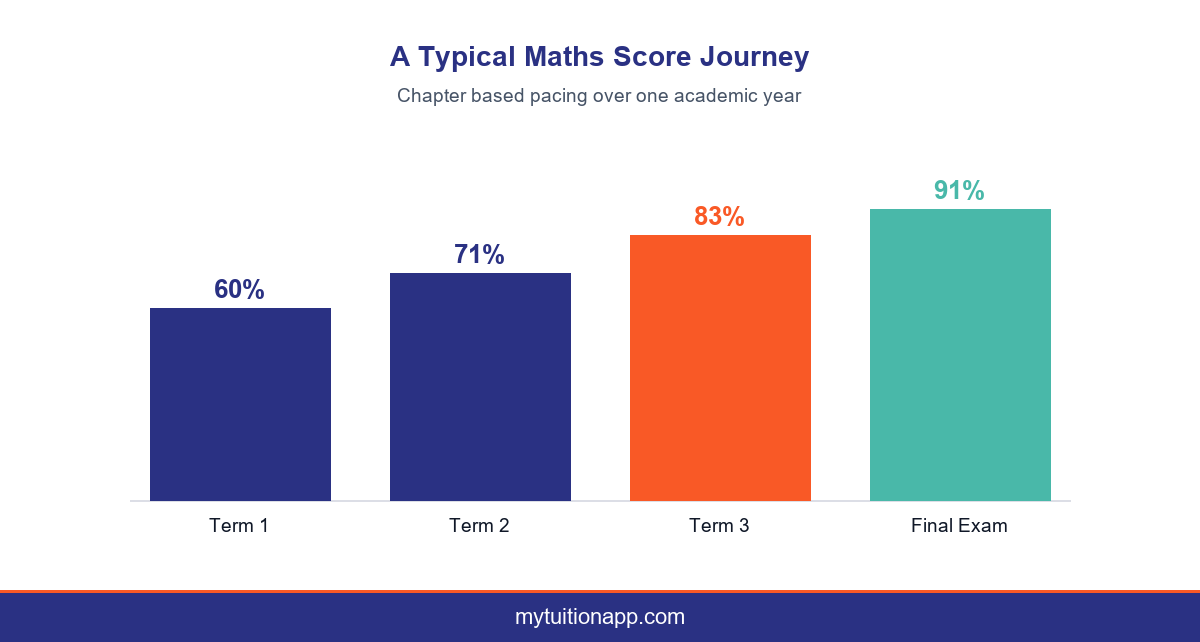
Improvement tends to happen gradually across three or four checkpoints over an academic year. It rarely arrives as one sudden jump before the final exam.
A student starting around 60 percent in Term 1 typically moves into the low seventies by Term 2. This happens once the specific earlier gap has been identified and addressed directly. By Term 3, scores in the low to mid eighties are common, as chapter based practice compounds across the syllabus. The final exam score, often above 90 percent, usually reflects a full year of steady, chapter by chapter correction rather than a last minute push. This gradual pattern is worth setting as an expectation from the start. Families sometimes expect a faster turnaround and lose confidence around Term 1 or 2, right before the improvement becomes visible.
The Term 1 to Term 2 jump is usually the smallest of the three. Most of that period is spent diagnosing and correcting the original gap rather than adding new content. The larger jumps tend to happen in Term 2 to Term 3, and Term 3 to the final exam. By then, the earlier gap is resolved, and chapter based practice starts compounding across newer material without the same old mistake resurfacing each time.
What Changed: Chapter Based Pacing Instead of Repeated Cramming
The core shift moves away from broad, repeated revision of the entire syllabus. Instead, it focuses on chapter by chapter correction of the specific gap causing lost marks.
Many students arrive at CBSE maths coaching online already having tried general revision, extra practice papers, or repeating an entire chapter from the textbook. None of it brought meaningful improvement. This usually fails because it treats the whole subject as the problem, when the actual issue is narrower. The Personalised Chapter Model instead identifies the specific chapter or concept causing the most lost marks. It concentrates repeated, guided practice there first, before moving through the rest of the syllabus at a more typical pace. Our guide on how chapter wise learning beats last minute exam prep explains this same mechanism in more depth.
The Turning Point: Numerical Practice and Doubt Clearing Habits
The actual turning point in most of these journeys is not a single lesson. It is a change in two specific habits: how numerical problems are practised, and how quickly doubts get addressed.
Students who improve significantly tend to move from occasional, unstructured practice to regular, reviewed practice. A teacher checks actual working, not just final answers, catching small errors in method before they become ingrained habits. Doubt clearing also shifts, from waiting until the next scheduled class to being addressed close to when the doubt actually comes up. This prevents a small confusion from compounding across several subsequent lessons that all build on the same unresolved concept.
Neither of these changes feels dramatic in any single session. This is part of why the improvement often surprises families more than the student. By the time report cards catch up to reflect it, the student has simply been doing focused, corrected practice consistently for months.
A third, smaller habit shift also plays a role. Students improving significantly tend to move from treating a wrong answer as a final result, to treating it as information about which step went wrong. This sounds subtle, but it changes how a student responds to a mistake. Instead of frustration or avoidance, they move toward identifying and fixing the step that failed. It is a habit that transfers well beyond Maths alone.
What Parents Notice Before the Grades Do
Score improvement is usually preceded by a change in how a student talks about Maths at home. This happens well before it shows up on a report card.
Parents commonly describe a shift from avoiding Maths homework to attempting it independently first. Sometimes it is a student asking a specific question about a concept, rather than a general complaint that a chapter is hard. These behavioural signals tend to appear a term or so before the corresponding score improvement becomes visible. This is worth knowing, so a family does not lose confidence during the gap between the behaviour change and the eventual grade change.
Regular, chapter level updates from a tutor help here too. They give a parent something more concrete to track than simply waiting for the next report card. Seeing that a specific gap has been addressed in a given week, even before it shows up as a grade, is often the reassurance a family needs. It helps them stay consistent through the slower early months of the process.
The Pattern Is Consistent Even When the Timeline Varies
CBSE maths coaching online that works tends to follow this same broad pattern. Identify the specific earlier gap. Correct it through focused, chapter based practice. Then let steady, reviewed numerical work compound over a full academic year, rather than expecting a quick fix. The exact timeline varies by student. The underlying mechanism, chapter based correction over broad repetition, stays consistent. Book a free demo class to see how this same approach would apply to your child’s specific Maths gaps.
Frequently Asked Questions
How long does it typically take to improve from weak Maths fundamentals to a strong score?
Most improvement happens gradually across a full academic year. It moves through three or four checkpoints rather than one sudden jump right before the final exam.
Is a low Maths score usually a sign of weak ability overall?
Not usually. Most students scoring low have a specific, identifiable gap in one earlier chapter or concept. It is rarely a general weakness across the entire subject.
Why does general revision often fail to improve a weak Maths score?
General revision treats the whole subject as the problem. The actual issue is usually narrower, needing focused correction on one or two specific concepts instead.
What is the biggest change in habit behind most improvement stories?
Regular, reviewed numerical practice, where a teacher checks actual working, tends to matter more than any single explanation. Faster doubt clearing adds to that effect.
Do parents notice improvement before it shows up in grades?
Yes. A shift toward attempting homework independently, or asking more specific questions, often appears first. The corresponding score improvement usually shows up on a report card a term later.
Does chapter based coaching work for students who are not currently struggling?
Yes, though the case is strongest for students with an identifiable gap. Students performing well still benefit too. Pacing that matches their own progress works better than a fixed batch schedule.
What is the Personalised Chapter Model in this context?
It is the teaching structure behind this approach. Repeated, guided practice focuses on the specific chapter or concept causing the most lost marks. Only then does teaching move through the rest of the syllabus.
Why do some families lose confidence in coaching before results show?
Improvement is gradual. Score jumps often appear later than the underlying habit changes. This can feel discouraging around Term 1 or 2, if expectations are not set correctly from the start.
Can this same approach apply to subjects other than Maths?
Our guide on why CBSE students lose interest in traditional coaching covers this too. The same chapter based correction principle applies across Science and other subjects as well.
How can a parent compare pricing for this kind of chapter based Maths coaching?
Our fees and formats checklist explains batch sizes, session formats, and costs. These apply the same way to Maths coaching as to other CBSE subjects.