Online tuition for CBSE Class 6 is rarely the first thing a family considers, since Class 6 does not carry the obvious pressure of a board exam year. Class 6 is also the point where CBSE Science and Social Science split off as separate, more demanding subjects for the first time, which is exactly why the habits a student builds this year tend to carry forward for several years afterward. This guide looks at what actually changes in Class 6, why it is worth taking seriously from the start, and what a genuinely useful first tuition experience should look like.
Key Takeaways
- Class 6 splits combined EVS into separate Science and Social Science subjects, a bigger structural change than most families expect.
- Study habits and independence expectations shift noticeably from a single class teacher to multiple subject teachers.
- Chapter based tuition started early in Class 6 tends to prevent the small early gaps that become harder problems by Class 8 or 9.
Why Class 6 Is a Bigger Jump Than It Looks
Class 6 marks the shift from primary school structure to middle school structure, which is a bigger change than the absence of a board exam might suggest.
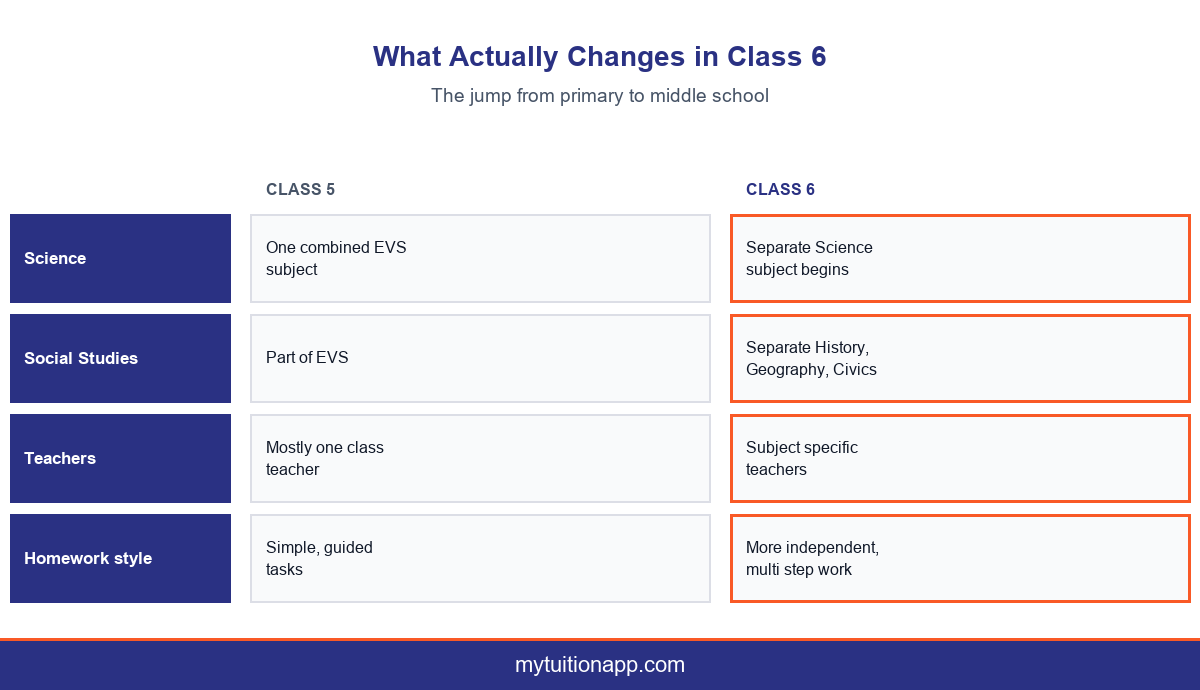
In Class 5, most CBSE students study Environmental Studies, or EVS, as a single combined subject taught largely by one class teacher. Class 6 splits this into separate Science and Social Science subjects, each taught by a different subject specialist, with noticeably more content depth than EVS covered at any point. This is often the first time a CBSE student has to manage genuinely different subject teachers, subject specific homework, and content that no longer overlaps as neatly as EVS once did.
Because this shift happens quietly, without the fanfare of a board exam year, many families do not treat Class 6 with the same seriousness they eventually apply to Class 9 or 10, even though the study habits formed in Class 6 tend to persist for years afterward, for better or worse.
There is also a practical reason Class 6 gets less attention. Tuition budgets in many families are reserved for board exam years specifically, meaning a Class 6 student often manages this transition entirely independently. Independent management is not inherently a problem, but it does mean any gap in how well a student adapts to the new structure goes unnoticed for longer than it would if a tutor were tracking progress from the start.
What Actually Changes From Class 5 to Class 6
A few specific, concrete changes define the Class 5 to Class 6 transition, beyond the general sense that school becomes harder.
Science becomes its own subject rather than a section within EVS, introducing more structured, factual content that builds progressively rather than standing alone chapter to chapter. Social Science similarly splits into distinct History, Geography, and Civics components rather than the loosely combined EVS format. Students move from mostly one class teacher to several subject specific teachers, each with different expectations and teaching styles to adjust to simultaneously. Homework shifts from simple, guided tasks toward more independent, multi step assignments that assume a level of self direction many Class 6 students have not yet had to practise.
The Risk of Waiting to See How Class 6 Goes
Many families take a wait and see approach in Class 6, reasoning that tuition can always start later if it turns out to be needed.
This approach carries a specific risk in Class 6 specifically, since the subject is genuinely new for everyone. A student who struggles with the separate Science or Social Science format in Class 6 is not necessarily behind in ability, but simply adjusting to a structure that did not exist in Class 5. Without support at this stage, small gaps in how a student organises subject specific study time can compound quietly across Class 7 and 8, becoming much harder to isolate and fix by the time Class 9 content builds directly on top of them.
Our guide on why CBSE students lose interest in traditional coaching touches on a related pattern, where early disengagement from a subject, if left unaddressed, tends to compound rather than resolve on its own as content gets progressively more demanding in later classes.
The wait and see approach also assumes a problem will be obvious enough to notice in time, which is not always true for a subject a student has never studied in its current form before. A student cannot easily tell a parent that Social Science feels harder than expected if they have no prior version of the subject to compare it against, which is exactly the kind of gap that benefits from an outside check rather than waiting for a struggling report card to make it obvious.
How Chapter Based Tuition Fits a First Time Tuition Family
For a family arranging tuition for the first time, the Personalised Chapter Model offers a structure that does not assume a student already knows how to manage subject specific, independent study.
Rather than starting a Class 6 student on a fixed weekly batch schedule built for students who already have established study habits, chapter based pacing adapts to how quickly a specific student adjusts to the new Science and Social Science format. A student who needs extra time adjusting to Social Science’s shift away from EVS gets it, without falling behind in the process. This matters more for a first time tuition family than for one already familiar with how structured academic support works, since the format itself is new on both fronts.
Regular parent updates matter just as much here as the pacing itself, since a family new to structured tuition often does not yet know what a normal rate of progress should look like. Specific, chapter level feedback gives a first time tuition family a concrete reference point, rather than leaving them to guess whether their child’s adjustment to Class 6 is on track.
What a Free Demo Class Should Show a Class 6 Parent
A demo class for a first time Class 6 family should demonstrate patience with genuinely new content, not just teaching competence in general.
It is worth watching specifically how a teacher introduces a new Science or Social Science concept to a student encountering the subject in its separated form for the first time, rather than assuming prior exposure the way a Class 8 or 9 demo class reasonably might. A demo class that moves at a pace suited to a genuinely new subject, rather than a generic pace built for any grade, is a good early signal for a family starting from Class 6 specifically.
It is also worth asking directly how the programme handles a Class 6 student who has never had a subject specific teacher before, since the answer reveals whether a provider has genuinely thought about this transition or is simply applying the same approach used for every other grade regardless of what actually changes at this stage.
Class 6 Sets the Pattern for Everything After It
Online tuition for CBSE Class 6 matters more than its lack of board exam pressure suggests, since this is the year Science and Social Science first become their own demanding subjects, and the habits formed here tend to carry forward for years. Chapter based pacing suited to a genuinely new academic structure gives a Class 6 student the right start rather than assuming skills that have not been built yet. Book a free demo class to see how this works for your child from the very first chapter.
Frequently Asked Questions
What changes for a CBSE student moving from Class 5 to Class 6?
EVS splits into separate Science and Social Science subjects, students move from mostly one teacher to several subject specialists, and homework becomes more independent and multi step.
Does Class 6 have a board exam like Class 10?
No. Class 6 has no board exam, but it introduces the subject structure and study habits that carry forward through the rest of CBSE schooling, making it worth taking seriously early.
Is it too early to start tuition in Class 6?
Not necessarily. Starting early helps address adjustment gaps from the new subject structure before they compound into larger problems by Class 8 or 9.
Why does Social Science feel harder in Class 6 than EVS did in Class 5?
Social Science splits into distinct History, Geography, and Civics components in Class 6, replacing the loosely combined format EVS used in earlier classes.
What should a parent look for in a Class 6 demo class specifically?
Watch for a teaching pace suited to genuinely new content, since a Class 6 student is often encountering separated Science and Social Science subjects for the first time.
How does chapter based tuition help a first time tuition family?
Pacing adapts to how quickly a specific student adjusts to new subject formats, rather than assuming established study habits a fixed weekly batch schedule often expects.
Do all CBSE schools introduce separate Science and Social Science in Class 6?
This follows the standard CBSE curriculum structure, though pacing and depth can vary slightly by individual school implementation.
What happens if early Class 6 adjustment gaps are left unaddressed?
Our guide on why CBSE students lose interest in traditional coaching explains how early, unresolved gaps tend to compound rather than resolve as content gets more demanding in later classes.
Is cramming an effective strategy in Class 6?
Our guide on how chapter wise learning beats last minute exam prep explains why steady, paced learning produces better long term retention than last minute revision, even without board exam pressure.
How can a parent compare pricing for Class 6 tuition?
Our fees and formats checklist explains batch sizes, session formats, and costs, which apply the same way to Class 6 as to other CBSE classes.